FlexGuard Official Website › Blog › FlexGuard Ingredients: An 8-Row Label Checklist
FlexGuard Ingredients: An 8-Row Label Checklist
FlexGuard lists eight actives, each with its own weight: glucosamine sulfate 500 mg, Indian frankincense 67 mg, chondroitin sulfate 50 mg, turmeric root 50 mg, and quercetin, methionine, MSM and bromelain at 8 mg each. That is 699 mg per capsule, with hypromellose and rice flour. It contains shellfish.
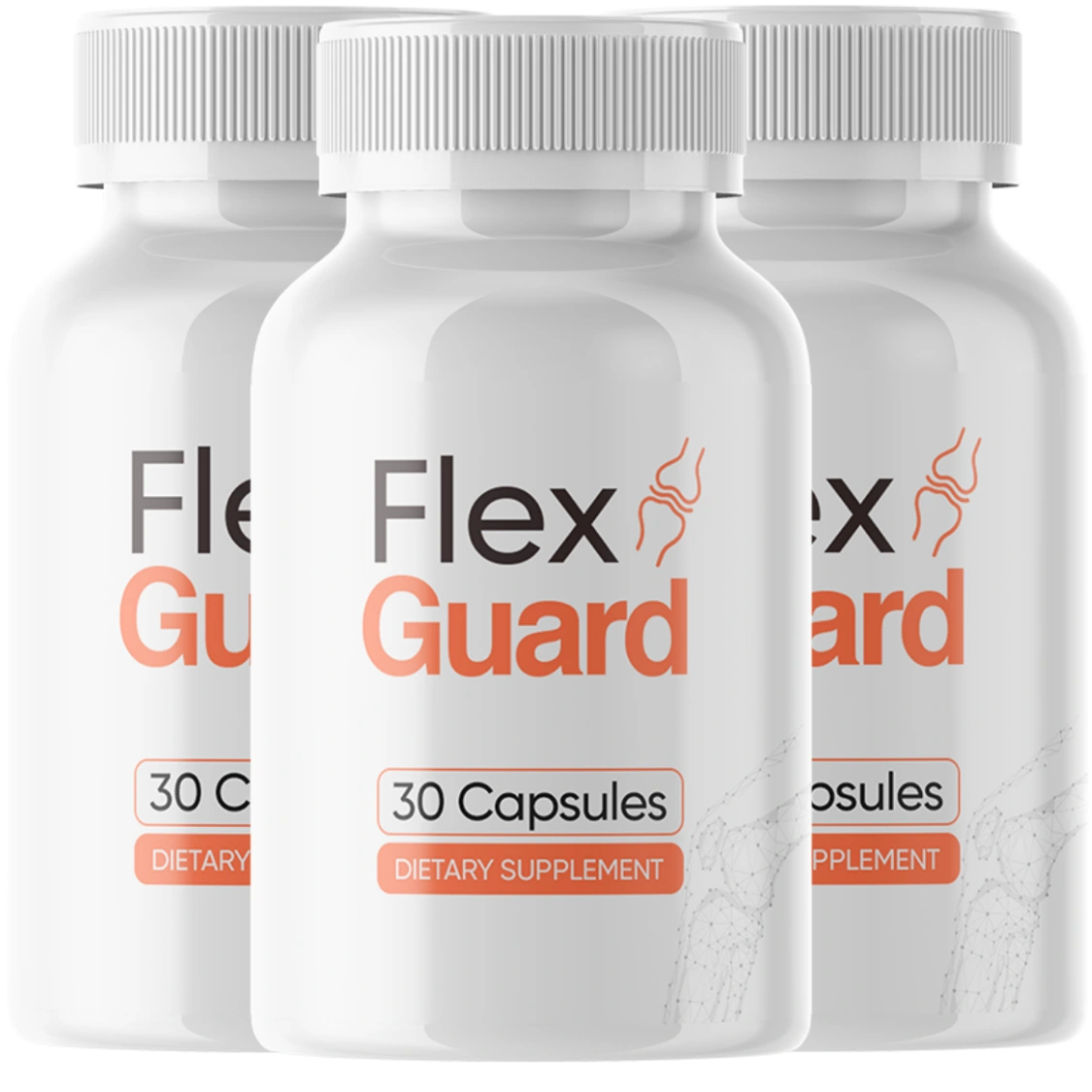
Want the label in your hands?
The panel on this page is the one printed on the carton. The seller's checkout shows the live price and the guarantee.
See today’s price and guaranteeWe earn a payment on orders placed through this site, because it is a retailer. The live price is at the checkout, and it wins over any page.
- Serving size is 1 capsule, with 30 servings per container. There is no proprietary blend.
- Eight actives total 699 mg: glucosamine sulfate is 72% of that, and four rows are only 1% each.
- Other ingredients: hypromellose (the vegetable capsule) and rice flour.
- The carton reads CONTAINS: SHELLFISH (CRAYFISH). No Daily Value is established for any row.
- Not on the label: a standardisation figure for Boswellia, the curcumin share of the turmeric, or where each ingredient was grown.
- It lists no vitamins. It is not a gummy, a tablet or liquid drops.
What is on the FlexGuard ingredients list?
The Supplement Facts panel on the carton lists eight rows. Each has a weight. One capsule is the serving, and a bottle holds 30 servings.
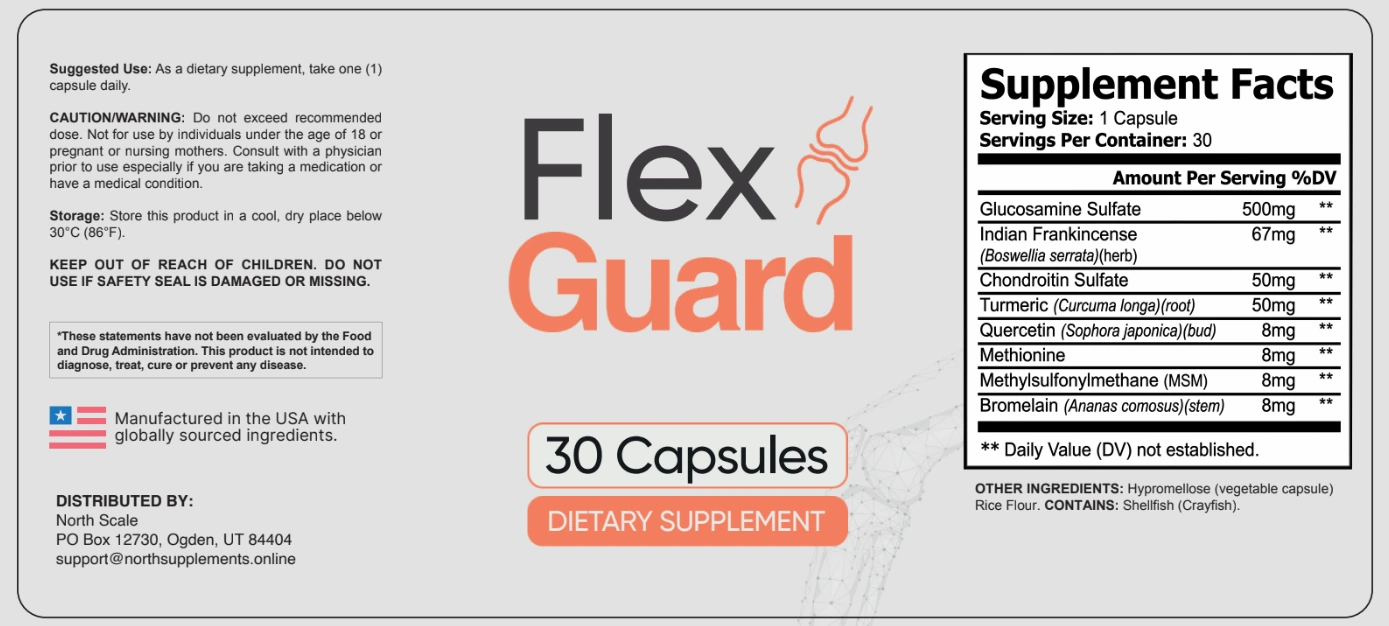
Below the rows you will find the other ingredients: hypromellose and rice flour. Hypromellose is the capsule shell, and it is a plant material. Rice flour is the filler.
There is no magnesium stearate, silica, titanium dioxide or colouring listed. The site calls a two-item other-ingredients line short for this shelf, and a small point in the product's favour.
There are also no vitamins on the list, so a search for a “flex guard vitamin” will not match this label. This is a joint-focused capsule with plant, amino and enzyme rows.
Use the checklist below with the carton in your hand. For each row we give the amount, what the ingredient is, and one thing to check.
People look this up as flex guard ingredients, flexguard ingredients list, flexguard supplement ingredients, flex guard label, flexguard label, flexguard supplement facts or flexguard formula. All of them point at one panel. The wider search, joint supplement ingredients, leads to the same six names that fill most of the category, and the table in check 1 of the post on whether joint supplements work lists them.
Row 1: What is glucosamine sulfate, and what does 500 mg mean?
Glucosamine is an amino sugar that the body uses in cartilage and joint fluid. It is made from shellfish shell, which is why the carton declares an allergen.
The row is 500 mg, and it is 72% of the whole 699 mg. The long trials used 1,500 mg a day, and in the large ones it was 500 mg three times a day. So 500 mg once is a third of the trial amount, taken in one go.
Check: the salt form. The label says sulfate, which is the form the long European trial used. The American GAIT trial used the hydrochloride.
Row 2: What is Indian frankincense (Boswellia serrata) at 67 mg?
Boswellia is the resin of the Indian frankincense tree. Its boswellic acids are studied for effects on inflammatory signalling. A 2025 network meta-analysis ranked it first for pain and stiffness among the supplements compared.
The catch is the way it is listed. The row says herb, 67 mg, with no standardisation. The trials used extracts standardised to a stated percentage of AKBA, at 100 to 250 mg a day, or 999 mg a day of crude extract.
Check: ask yourself whether you can compare 67 mg of herb with 100 mg of a 30 per cent extract. The site says you cannot, and the federal rule does not require the figure.
Row 3: What is chondroitin sulfate at 50 mg?
Chondroitin is a long sugar chain found in cartilage. It is usually sold with glucosamine. The Cochrane review pooled 43 trials and 9,110 people. It found a small gain in pain in shorter studies, shrinking as study quality rose.
Most of those trials used 800 to 1,200 mg a day. The two-year STOPP trial used 800 mg. At 50 mg, FlexGuard carries a sixteenth of the lowest trial figure.
Check: the amount, not the name. A familiar name on a label does not mean a familiar dose.
Row 4: What is turmeric root at 50 mg?
Turmeric is the most-trialled plant in joint research. An umbrella review of eleven meta-analyses found improvement in pain scores. One 367-patient trial compared 1,500 mg of extract a day with ibuprofen for four weeks.
Absorption is the known problem. Curcumin on its own reaches the blood poorly, so many products add something to help. This row names the root, gives 50 mg, and names no absorption aid.
Check: the label does not say what share of the 50 mg is curcumin. Also note that a liver-injury case series exists for turmeric, almost all at far higher amounts than 50 mg.
Row 5: What is quercetin at 8 mg?
Quercetin is a flavonoid. Here it comes from the bud of the Japanese pagoda tree, not from onions or apples. It has drawn recent interest as a senolytic, a compound studied for clearing worn-out cells.
The pooled joint evidence is animal and laboratory work. No randomised trial has tested quercetin in human joints, at any amount.
Check: 8 mg is a number with nothing to compare it to. It is not a small version of a tested dose, because no tested dose exists.
Row 6: What is methionine at 8 mg?
Methionine is an essential amino acid with sulfur in it. It is in every protein-rich food. The body uses it to make S-adenosylmethionine, or SAMe.
The joint research belongs to SAMe, studied at 600 to 1,200 mg a day. Methionine is the building block, not the finished molecule.
Check: search results for the word on the label will show a different compound. A normal day's food supplies well over a gram of methionine.
Row 7: What is MSM at 8 mg?
MSM is methylsulfonylmethane, an organosulfur compound sold on the idea that it supplies sulfur for connective tissue. People who search “what is msm joint supplement” are asking about this row.
A 2017 review puts normal use at 1.5 to 6 grams a day. A 2023 trial in mild knee pain used 2 grams a day for twelve weeks. An earlier systematic review called the evidence promising and thin.
Check: 8 mg is roughly a two-hundred-and-fiftieth of that 2 gram amount.
Row 8: What is bromelain at 8 mg?
Bromelain is a mix of protein-digesting enzymes from pineapple stem, used in Europe for swelling after injury.
The studies are mixed. An open study used 200 mg and 400 mg a day and saw more at the higher amount. A placebo-controlled pilot at 800 mg a day did not beat placebo. A 16-week trial used 1,890 mg a day of a bromelain preparation.
Check: the evidence is dose-dependent, so a small amount is harder to defend. The site says the evidence is mixed at hundreds of milligrams and absent at eight.
What does the FlexGuard label leave out?
A label is a declaration. It is not a lab report. The site lists what this one does not settle.
| Question | Does the panel answer it? |
|---|---|
| How much of each active is in a capsule? | Yes. Eight weights, no blend |
| What share of the Boswellia is AKBA? | No. A herb weight only |
| What share of the turmeric is curcuminoids? | No. The root and a weight |
| Where was each ingredient grown? | No. The origin line covers manufacture |
| Has this lot been assayed? | No. A certificate reference is printed, not the certificate |
Lot FLE-26/GO-6202 and reference FLE-6202-26-GO are filing references, not laboratory proof.
Read the full comparison on the ingredients page, and the panel itself on the supplement facts page.
This page is general information, not medical advice. FlexGuard is a dietary supplement, not a medicine, and no supplement is FDA approved. These statements have not been evaluated by the Food and Drug Administration, and the product is not intended to diagnose, treat, cure or prevent any disease. If you take a medicine, have a medical condition or are unsure about the shellfish line, talk to your doctor before the first capsule.
Frequently asked questions
What are the FlexGuard ingredients?
Glucosamine sulfate 500 mg, Indian frankincense (Boswellia serrata) 67 mg, chondroitin sulfate 50 mg, turmeric root 50 mg, and quercetin, methionine, MSM and bromelain at 8 mg each. Other ingredients are hypromellose and rice flour.
How much is in each FlexGuard capsule?
The eight named actives total 699 mg per capsule. One capsule is one serving, and there are 30 servings in a container.
Is there a proprietary blend in FlexGuard?
No. Every row has its own printed weight, so you can read each amount.
Does FlexGuard contain shellfish?
Yes. The carton reads CONTAINS: SHELLFISH (CRAYFISH). Glucosamine comes from shellfish shell, so the allergen is a property of the ingredient. The capsule shell itself is a plant material.
Is FlexGuard a vitamin?
No vitamins are listed on the panel. It is a joint-focused dietary supplement made of amino, plant and enzyme rows.
Does the label say how much curcumin is in the turmeric?
No. The row names turmeric root and gives 50 mg. It does not say what share is curcumin.
Sources named on this site
- The GAIT trial: https://pubmed.ncbi.nlm.nih.gov/16495392/
- The three-year glucosamine sulphate trial: https://pubmed.ncbi.nlm.nih.gov/11214126/
- The Cochrane review of chondroitin: https://pubmed.ncbi.nlm.nih.gov/25629804/
- The STOPP trial: https://pubmed.ncbi.nlm.nih.gov/19180484/
- The 2025 network meta-analysis of joint supplements: https://pubmed.ncbi.nlm.nih.gov/40806131/
- The 5-Loxin dose-ranging trial: https://pubmed.ncbi.nlm.nih.gov/18667054/
- The 2003 Boswellia knee trial: https://pubmed.ncbi.nlm.nih.gov/12622457/
- The 367-patient ibuprofen comparison: https://pubmed.ncbi.nlm.nih.gov/24672232/
- The 2024 umbrella review of eleven curcumin meta-analyses: https://pubmed.ncbi.nlm.nih.gov/38576215/
- The Drug-Induced Liver Injury Network's turmeric case series: https://pubmed.ncbi.nlm.nih.gov/36252717/
- The 2023 review of quercetin in osteoarthritis: https://pubmed.ncbi.nlm.nih.gov/37442369/
- The meta-analysis of S-adenosylmethionine: https://pubmed.ncbi.nlm.nih.gov/12019049/
- The 2017 review of methylsulfonylmethane: https://pubmed.ncbi.nlm.nih.gov/28300758/
- The 2023 MSM knee trial: https://pubmed.ncbi.nlm.nih.gov/37447322/
- The systematic review of DMSO and MSM in osteoarthritis: https://pubmed.ncbi.nlm.nih.gov/18417375/
- The dose-ranging bromelain study: https://pubmed.ncbi.nlm.nih.gov/12587686/
- The placebo-controlled bromelain pilot: https://pubmed.ncbi.nlm.nih.gov/17121765/
- The 16-week bromelain WOMAC trial: https://pubmed.ncbi.nlm.nih.gov/27470088/
- The federal rule for a Supplement Facts panel: https://www.ecfr.gov/current/title-21/chapter-I/subchapter-B/part-101/subpart-F/section-101.36
- The FDA's dietary supplement labeling guide: https://www.fda.gov/food/dietary-supplements-guidance-documents-regulatory-information/dietary-supplement-labeling-guide
Our view
The best thing about this label is that you can read it. Eight rows, eight weights, no blend. That lets you do what we did here: put each printed number next to the number the research used.
The honest result is mixed. Glucosamine carries most of the capsule at a third of the trial amount. Chondroitin and turmeric are a small fraction of theirs. Four rows are at 8 mg, with little or nothing to compare them to. Boswellia cannot be compared at all without a standardisation figure.
That does not make the capsule useless, and it does not make it a bargain. It makes it a broad capsule at modest amounts. If that is what you want, and the shellfish line does not rule you out, the label gives you everything you need to decide.
Last updated
Read the label, then decide
If the eight rows suit you, the seller's checkout shows current packs and the written 60-day terms. If the shellfish line rules you out, no pack changes that.
See today’s price and guaranteeThis site is a retailer, so it is paid on orders made through it. Prices on our pages were read on September 19, 2026, and the checkout is the current figure.