FlexGuard Official Website › How It Works
How It WorksHow Does FlexGuard Work? Three Kinds of Ingredients
FlexGuard works by putting three kinds of ingredient into one capsule.
Glucosamine and chondroitin are cartilage building blocks. Boswellia and turmeric act on inflammatory signalling. MSM, bromelain, quercetin and methionine add sulfur compounds, an enzyme and a flavonoid.
See the amounts on the ingredients page.
A mechanism is only worth describing if the capsule carries enough of the ingredient to use it. This page sets out the three routes first and then says plainly which of them this panel can and cannot support.
What does the seller say FlexGuard does?
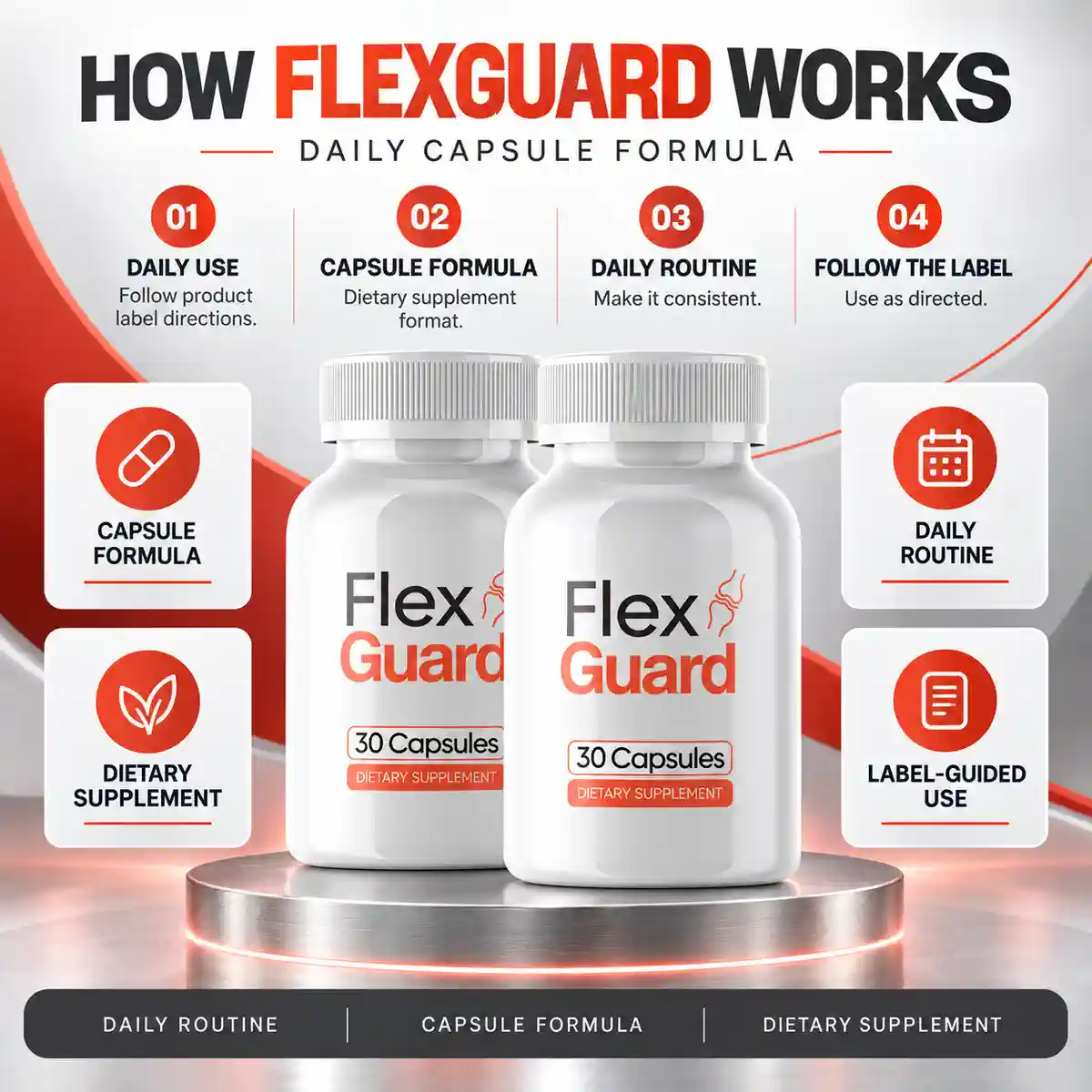
The seller's HOW FLEXGUARD WORKS graphic has four numbered steps: daily use, capsule formula, daily routine, follow the label. Read as a mechanism that is nothing at all. Read as a statement about adherence it is reasonable, and it is more restrained than most of this shelf manages.
It is also a decision with a consequence. A seller who claims no mechanism cannot be accused of overclaiming one, and a reader who wants to know how the capsule is supposed to act has to go to the panel. That is what the rest of this page does.
Route one: the FlexGuard cartilage building blocks
Glucosamine and chondroitin are both found in cartilage and in the fluid that lubricates a joint. The idea behind supplementing them is straightforward: supply the raw materials and the tissue has more to work with.
It is the most-tested idea in the category and the results are genuinely divided. A three-year trial of glucosamine sulphate at 1,500 mg a day reported less joint space narrowing than placebo. The GAIT trial, using 500 mg of glucosamine hydrochloride three times daily with or without chondroitin, found no benefit over placebo in its primary analysis. The Cochrane review of chondroitin found a small benefit that got smaller as the studies got better.
What almost every one of those trials shares is the amount: 1,500 mg of glucosamine a day and 800 to 1,200 mg of chondroitin. FlexGuard carries 500 mg and 50 mg. The route is real; the question is whether a third and a sixteenth of the tested amounts move anything.
The large glucosamine trials did not only use more. Most of them split it into three doses across the day, which is a different exposure pattern from a single morning capsule. The one trial that dosed once daily used the full 1,500 mg in that single dose.
Route two: the FlexGuard plant compounds
Boswellic acids from Indian frankincense inhibit 5-lipoxygenase, an enzyme in the leukotriene arm of inflammatory signalling. Curcuminoids from turmeric act more broadly, on several inflammatory pathways at once.
This is where the category's best recent result sits. A 2025 network meta-analysis of 39 randomised trials covering 4,599 patients ranked Boswellia first of the supplements compared for pain and stiffness, ahead of both glucosamine and curcumin. An earlier meta-analysis of seven trials reached a compatible conclusion on a smaller pool.
The catch on this panel is specification rather than amount. Boswellia trials are run on extracts standardised to a stated percentage of AKBA, because the active fraction is a small part of the resin. Sixty-seven milligrams of an unstandardised herb and 100 mg of a 30 per cent AKBA extract are not the same quantity of anything, and the carton gives the first.
| Compound | What it is thought to act on | What was tested |
|---|---|---|
| Boswellic acids | 5-lipoxygenase, in one inflammatory arm | 100–250 mg a day standardised, or 999 mg crude |
| Curcuminoids | Several inflammatory pathways | 1,500–2,000 mg a day of extract, usually with an absorption aid |
| Quercetin | Clearance of senescent cells, in laboratory work | No human joint trial at any amount |
The middle column describes a proposed mechanism, not an effect on a person. The right column is what was actually administered.
Route three: the FlexGuard sulfur, enzyme and amino acid rows
MSM supplies sulfur, which the body uses in connective tissue. Bromelain is a protein-digesting enzyme studied for swelling. Methionine is an amino acid and the precursor to S-adenosylmethionine.
All three have a route that can be described in a sentence and all three are on this panel at 8 mg. MSM was tested at 2 grams a day, bromelain between 200 and 400 mg, and S-adenosylmethionine at 600 to 1,200 mg. These are the rows where the mechanism is easy to state and the amount makes it academic.
Saying that plainly is more useful than describing each pathway at length. A mechanism is a reason something could work. An amount is the reason it might.
What FlexGuard cannot do, mechanically
It does not rebuild cartilage that has gone. It does not block pain the way an analgesic does, so there is no reason to expect anything within an hour of taking it. And it does not treat, prevent or manage arthritis or any other named condition. The rheumatology guideline puts exercise, weight management and self-management above every supplement it reviewed.
The honest ceiling on what any of this can mean is set by the carton, which claims support for joint comfort and mobility and for everyday joint stress. That is a claim about how a joint feels doing ordinary things, and it is the only claim this site makes.
Who publishes this FlexGuard mechanism page?
Thirteen sources, each linked in the sentence that uses it rather than collected here alone.
- Clegg DO, Reda DJ, Harris CL, et al. Glucosamine, chondroitin sulfate, and the two in combination for painful knee osteoarthritis. N Engl J Med. 2006;354(8):795-808. PMID 16495392. Dose: glucosamine hydrochloride 500 mg three times a day, chondroitin sulfate 400 mg three times a day, for 24 weeks. https://pubmed.ncbi.nlm.nih.gov/16495392/
- Reginster JY, Deroisy R, Rovati LC, et al. Long-term effects of glucosamine sulphate on osteoarthritis progression: a randomised, placebo-controlled clinical trial. Lancet. 2001;357(9252):251-6. PMID 11214126. Dose: 1,500 mg once a day for three years. https://pubmed.ncbi.nlm.nih.gov/11214126/
- Towheed TE, Maxwell L, Anastassiades TP, et al. Glucosamine therapy for treating osteoarthritis. Cochrane Database Syst Rev. 2005;2005(2):CD002946. PMID 15846645. https://pubmed.ncbi.nlm.nih.gov/15846645/
- Singh JA, Noorbaloochi S, MacDonald R, Maxwell LJ. Chondroitin for osteoarthritis. Cochrane Database Syst Rev. 2015;1(1):CD005614. PMID 25629804. Forty-three trials, 9,110 participants, most using 800 to 1,200 mg a day. https://pubmed.ncbi.nlm.nih.gov/25629804/
- Kahan A, Uebelhart D, De Vathaire F, Delmas PD, Reginster JY. Long-term effects of chondroitins 4 and 6 sulfate on knee osteoarthritis: the study on osteoarthritis progression prevention, a two-year, randomized, double-blind, placebo-controlled trial. Arthritis Rheum. 2009;60(2):524-33. PMID 19180484. Dose: 800 mg a day for two years. https://pubmed.ncbi.nlm.nih.gov/19180484/
- Yu G, Xiang W, Zhang T, Zeng L, Yang K, Li J. Effectiveness of Boswellia and Boswellia extract for osteoarthritis patients: a systematic review and meta-analysis. BMC Complement Med Ther. 2020;20(1):225. PMID 32680575. Seven trials, 545 patients; the pooled evidence covers four weeks and longer. https://pubmed.ncbi.nlm.nih.gov/32680575/
- Zhang Y, Gui Y, Adams R, et al. Comparative effectiveness of nutritional supplements in the treatment of knee osteoarthritis: a network meta-analysis. Nutrients. 2025;17(15):2547. PMID 40806131. Thirty-nine randomised trials, 4,599 patients; Boswellia ranked first for pain and stiffness. https://pubmed.ncbi.nlm.nih.gov/40806131/
- Bideshki MV, Jourabchi-Ghadim N, Radkhah N, et al. The efficacy of curcumin in relieving osteoarthritis: a meta-analysis of meta-analyses. Phytother Res. 2024;38(6):2875-2891. PMID 38576215. https://pubmed.ncbi.nlm.nih.gov/38576215/
- Toguchi A, Noguchi N, Kanno T, Yamada A. Methylsulfonylmethane improves knee quality of life in participants with mild knee pain: a randomized, double-blind, placebo-controlled trial. Nutrients. 2023;15(13):2995. PMID 37447322. Dose: 2 g a day for twelve weeks. https://pubmed.ncbi.nlm.nih.gov/37447322/
- Walker AF, Bundy R, Hicks SM, Middleton RW. Bromelain reduces mild acute knee pain and improves well-being in a dose-dependent fashion in an open study of otherwise healthy adults. Phytomedicine. 2002;9(8):681-6. PMID 12587686. Doses: 200 mg and 400 mg a day for one month. https://pubmed.ncbi.nlm.nih.gov/12587686/
- Soeken KL, Lee WL, Bausell RB, Agelli M, Berman BM. Safety and efficacy of S-adenosylmethionine (SAMe) for osteoarthritis. J Fam Pract. 2002;51(5):425-30. PMID 12019049. Trial doses ran 600 to 1,200 mg a day of SAMe, which is a molecule made from methionine rather than methionine itself. https://pubmed.ncbi.nlm.nih.gov/12019049/
- Yamaura K, Nelson AL, Nishimura H, et al. Therapeutic potential of senolytic agent quercetin in osteoarthritis: a systematic review and meta-analysis of preclinical studies. Ageing Res Rev. 2023;90:101989. PMID 37442369. The pooled evidence is preclinical: animal and laboratory work, not trials in people. https://pubmed.ncbi.nlm.nih.gov/37442369/
- Kolasinski SL, Neogi T, Hochberg MC, et al. 2019 American College of Rheumatology/Arthritis Foundation guideline for the management of osteoarthritis of the hand, hip, and knee. Arthritis Rheumatol. 2020;72(2):220-233. PMID 31908163. https://pubmed.ncbi.nlm.nih.gov/31908163/
More on how FlexGuard is meant to act
FlexGuard works on a calendar, not on an afternoon
Nothing on this panel has ever been shown to act inside a week. The three-bottle pack is the smallest one that reaches the window the trials read their results in.
Two bottles $158 · six bottles $294 · 60 days from the date of purchase
Order FlexGuard On The Official WebsiteOne capsule a day · 30 per bottle · lot FLE-26/GO-6202