FlexGuard Official Website › Choosing A Formula
Choosing A FormulaChoosing A Joint Supplement: Nine Checks
Nine checks, in the order they save you money.
Does the label print an amount for every ingredient. Does that amount reach the one the trials used. Is the botanical standardised. Is there an allergen. Is the routine one you will keep. Does the pack outlast the earliest sensible assessment. Is there a window, and when does it start. Who is the distributor. And what does the seller claim.
A checklist you can run on a bottle in a shop in about two minutes. This product is scored against all nine at the foot of the page, including the three it does not pass.
Check 1: is there an amount against every ingredient?
A panel that lists names under one blend total has told you the ingredients are present and nothing else. Under the federal panel rule a proprietary blend may declare a single weight for the whole group, with the components listed in descending order and no individual figures.
The consequence is arithmetic. In a 500 mg blend of eight names, the first could be 493 mg and the rest one milligram each, and the label would be entirely compliant. Descending order is a very weak constraint.
A panel with a weight against every row is the single most useful thing a label can carry, and it is the first thing to look for.
Eight rows, eight weights, no blend total. You can then add them up, compare each one with the published work, and decide with numbers rather than with adjectives.
Check 2: does the amount reach the researched one?
This is where most of the shelf fails, and it is not close. Glucosamine was tested at 1,500 mg a day. Chondroitin at 800 to 1,200 mg. MSM at 1.5 to 6 grams. Curcumin extract at 1,500 to 2,000 mg.
A capsule has a fixed internal volume. Reaching even one of those amounts usually means two or three capsules a day, which is why the products that do reach them are the single-ingredient ones and why a broad eight-in-one capsule arithmetically cannot be.
Neither shape is dishonest. What is dishonest is a broad capsule sold with the reputation of a single-ingredient trial attached to it.
Check 3: is the botanical standardised?
A plant extract's active fraction is a small and variable part of the plant. Boswellia trials specify a percentage of AKBA. Curcumin trials specify curcuminoid content. Without those figures, two labels printing the same milligram can contain very different amounts of the thing that was studied.
A row reading Boswellia serrata 67 mg tells you the weight of herb. A row reading Boswellia serrata extract 100 mg standardised to 30 per cent boswellic acids tells you what is in it. The second is comparable with the published trials and the first is not.
Check 4: is there an allergen, and does it apply to you?
Glucosamine is usually made from shellfish shell, so most glucosamine products carry a shellfish declaration. Some use a fermented plant-derived glucosamine instead and say so.
A controlled tolerance study found fifteen shrimp-allergic adults took shellfish-derived glucosamine without reacting, because the allergenic protein is in the flesh rather than the shell. That is a genuinely useful finding, and it is fifteen people. A label that names an allergen has named it, and the conservative reading is the correct one.
Check the other-ingredients line as well. It is where the capsule shell lives, and a gelatin shell rules out more diets than most people expect.
Check 5: is the routine one you will actually keep?
Three capsules a day at the researched amount beats one capsule at a third of it, on paper. In practice it only beats it if the three get taken.
Adherence is what supplement trials lose people to, and a category that needs eight to twelve weeks before it says anything is the worst possible place to be optimistic about your own habits. Be honest about which bottle you will still be opening in week nine.
Check 6: does the pack outlast the assessment point?
A thirty-capsule bottle of a once-daily product is thirty days. The earliest sensible point to judge anything in this category is around eight weeks, and for the cartilage ingredients it is three months.
So a single bottle is not a trial. It is a sample, and it will almost always produce the answer nothing happened, whatever the product. Work out the assessment date first and buy backwards from it.
Check 7: is there a window, and when does it start?
Two different sentences, and most buyers read only the first. A sixty-day guarantee that opens at purchase is shorter than a sixty-day guarantee that opens at dispatch, by the processing time and the transit time together. The earlier start is the safer one to plan against.
Check which one you are being offered, and check who pays the return postage. The usual answer is that you do, unless the item arrived damaged, defective or wrong, and that is normal rather than mean.
Sixty days from the shipping date and sixty days from purchase are different offers with the same headline. So are thirty days on unopened bottles and sixty days on opened ones. The number is the least informative part of the sentence, and where two documents give two different starts, the earlier one is the safe date to work to.
Check 8: who is the distributor, and can you find them?
A compliant label names a distributor with an address. That is the party responsible for the product, and a product with no identifiable owner is a product with nobody to answer a question about it.
The FDA's labelling guide sets out what a supplement label has to carry, and third-party verification programmes exist because a manufacturer's own paperwork and an independent measurement are different things. Verification is rare, voluntary and expensive, so most of this shelf does without it, and its absence is ordinary rather than suspicious.
Check 9: what does the seller actually claim?
A dietary supplement may make structure and function claims: supports joint comfort, supports mobility. It may not claim to treat, prevent or manage a named condition, and a seller who does has told you something about their judgement rather than about their product.
The FTC's guidance on health product claims is the standard. Read the front of the box and the marketing page side by side. A product whose claims stop where the rules stop is more likely to have been careful about everything else too.
Scoring FlexGuard against all nine
| Check | Result | Why |
|---|---|---|
| 1. An amount against every ingredient | Pass | Eight rows, eight weights, no blend total. |
| 2. Does it reach the researched amount | Fail | Six of eight rows are below, four by an order of magnitude or more. |
| 3. Is the botanical standardised | Fail | The Boswellia row gives a herb weight with no AKBA figure. |
| 4. Allergen declared | Pass | Contains shellfish (crayfish), printed on the carton. |
| 5. A routine you will keep | Pass | One capsule, once a day, no loading phase. |
| 6. Pack outlasts the assessment | Pass with a caveat | The smallest pack is sixty days, which reaches the front of the window and no further. |
| 7. A window, and when it starts | Pass with a caveat | Sixty days, and two documents start it on two different dates. Both are printed on the guarantee page. |
| 8. An identifiable distributor | Pass | North Scale of Ogden, Utah, named on the carton with an address. |
| 9. Claims inside the rules | Pass | Two structure and function claims, and no condition is named. |
Seven passes, one of them qualified, and two failures. Both failures are about amount and specification rather than about honesty.
That is a fair score for a broad once-daily capsule and it is not a recommendation on its own. Checks 2 and 3 are the two that decide whether the ingredients can do what their reputation says, and this product does not pass either of them. Checks 1, 4, 8 and 9 are the ones that decide whether you are being told the truth, and it passes all four.
Sources for this checklist
Twelve sources. Four of them are the rules a label has to obey, which is what most of these checks are actually testing.
- 21 CFR 101.36, Nutrition labeling of dietary supplements. Electronic Code of Federal Regulations. https://www.ecfr.gov/current/title-21/chapter-I/subchapter-B/part-101/subpart-F/section-101.36
- Dietary Supplement Labeling Guide. U.S. Food and Drug Administration. https://www.fda.gov/food/dietary-supplements-guidance-documents-regulatory-information/dietary-supplement-labeling-guide
- Health Products Compliance Guidance. U.S. Federal Trade Commission, December 2022. https://www.ftc.gov/business-guidance/resources/health-products-compliance-guidance
- Dietary Supplements Verification Program. United States Pharmacopeia. https://www.usp.org/verification-services/dietary-supplements-verification-program
- Villacis J, Rice TR, Bucci LR, et al. Do shrimp-allergic individuals tolerate shrimp-derived glucosamine? Clin Exp Allergy. 2006;36(11):1457-61. PMID 17083356. Fifteen shrimp-allergic adults took 1,500 mg of shrimp-derived glucosamine with no allergic reaction; the allergen is in the flesh, not the shell. https://pubmed.ncbi.nlm.nih.gov/17083356/
- Sengupta K, Alluri KV, Satish AR, et al. A double blind, randomized, placebo controlled study of the efficacy and safety of 5-Loxin for treatment of osteoarthritis of the knee. Arthritis Res Ther. 2008;10(4):R85. PMID 18667054. Doses: 100 mg and 250 mg a day of an extract standardised to 30 per cent 3-O-acetyl-11-keto-beta-boswellic acid. Funded by the extract's manufacturer. https://pubmed.ncbi.nlm.nih.gov/18667054/
- Reginster JY, Deroisy R, Rovati LC, et al. Long-term effects of glucosamine sulphate on osteoarthritis progression: a randomised, placebo-controlled clinical trial. Lancet. 2001;357(9252):251-6. PMID 11214126. Dose: 1,500 mg once a day for three years. https://pubmed.ncbi.nlm.nih.gov/11214126/
- Singh JA, Noorbaloochi S, MacDonald R, Maxwell LJ. Chondroitin for osteoarthritis. Cochrane Database Syst Rev. 2015;1(1):CD005614. PMID 25629804. Forty-three trials, 9,110 participants, most using 800 to 1,200 mg a day. https://pubmed.ncbi.nlm.nih.gov/25629804/
- Butawan M, Benjamin RL, Bloomer RJ. Methylsulfonylmethane: applications and safety of a novel dietary supplement. Nutrients. 2017;9(3):290. PMID 28300758. Human studies have used 1.5 to 6 g a day. https://pubmed.ncbi.nlm.nih.gov/28300758/
- Bideshki MV, Jourabchi-Ghadim N, Radkhah N, et al. The efficacy of curcumin in relieving osteoarthritis: a meta-analysis of meta-analyses. Phytother Res. 2024;38(6):2875-2891. PMID 38576215. https://pubmed.ncbi.nlm.nih.gov/38576215/
- Using Dietary Supplements Wisely. National Center for Complementary and Integrative Health, National Institutes of Health. https://www.nccih.nih.gov/health/using-dietary-supplements-wisely
- Dietary Supplements: What You Need to Know. Office of Dietary Supplements, National Institutes of Health. https://ods.od.nih.gov/factsheets/WYNTK-Consumer/
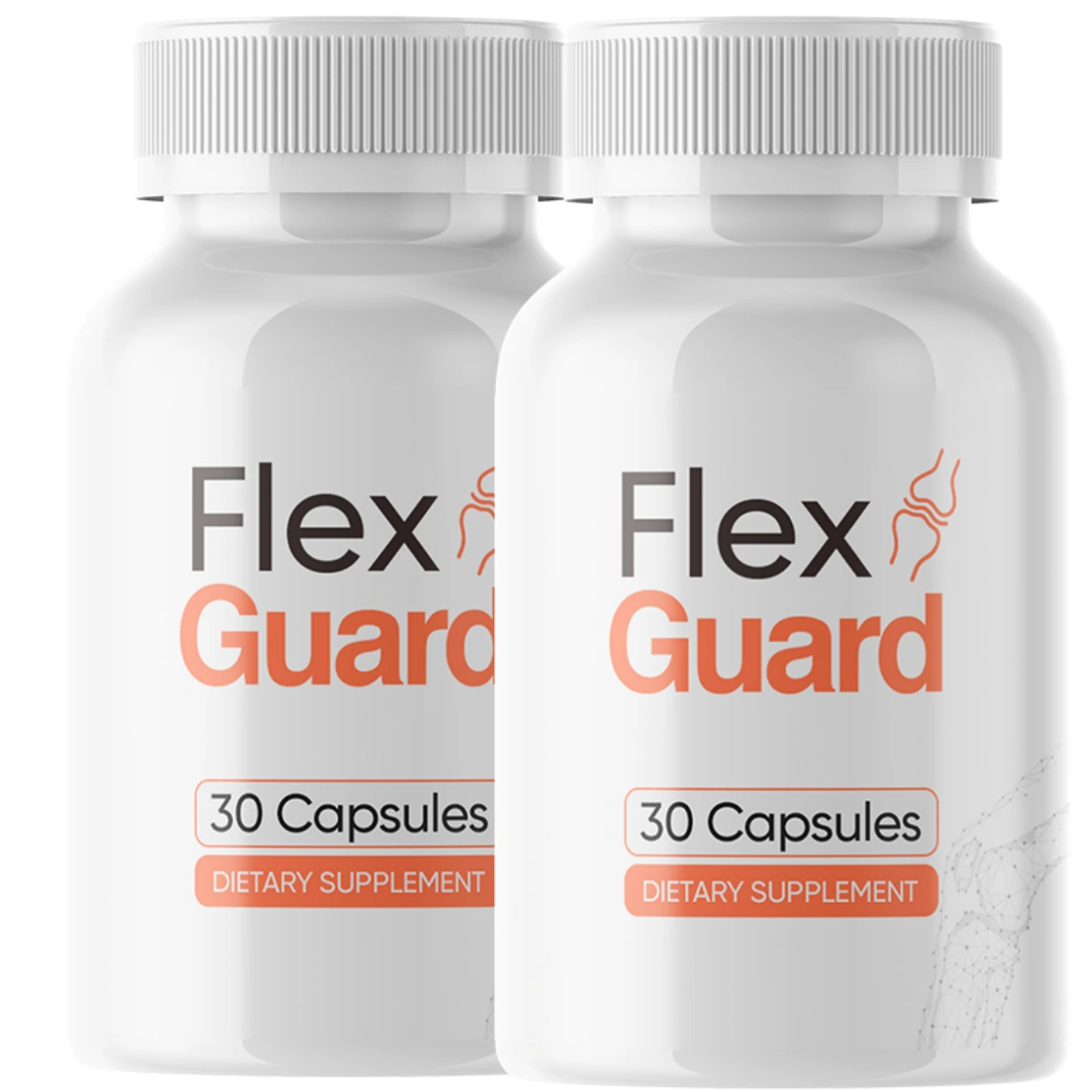
FlexGuard passes seven of these nine checks
It fails on amount and on standardisation, and those two are stated with the figures on the ingredients page rather than buried at the foot of a table.
Two bottles $158 · six bottles $294 · 60 days from the date of purchase
Order FlexGuard On The Official WebsiteOne capsule a day · 30 per bottle · lot FLE-26/GO-6202