FlexGuard Official Website › How To Use
How To UseHow to Take FlexGuard: Dose, Timing and Storage
Take one FlexGuard capsule a day, with water, at an hour you will not forget.
There is no food rule, no loading week and no second dose. A 30-capsule bottle lasts a month. Store it cool and dry, below 30 degrees Celsius.
For what to expect, read the FlexGuard results timeline.
Six steps, and only the first comes off the carton. The other five are about making a daily habit survive a real week, which is the thing most people get wrong about a supplement they bought three months of.
The six steps for taking FlexGuard
In order, and the last one is the one that decides whether the other five were worth doing.
Take one capsule a day
As a dietary supplement, take one (1) capsule daily. There is no loading phase, no second capsule and no cycling instruction on the carton. One is the whole dose.
Pick an hour and keep it
No hour of the day has been shown to suit this formula better than another. What has been shown, repeatedly, is that supplement trials lose people to forgetting. Tie the capsule to something you already do without deciding to.
Swallow it with water, with food if it suits you
The carton asks for neither. Glucosamine is easier on an unsettled stomach with a meal, and a meal is also a more reliable anchor than a clock.
Write two dates down
The day you took the first capsule, and the purchase date from the order email. The first tells you when to judge it. The second tells you when the window closes.
Keep the bottle out of the bathroom
Store this product in a cool, dry place below 30°C (86°F). A bathroom cabinet is the warmest, dampest storage in most homes, and the carton asks for the opposite of both.
Judge it at week eight, not week two
The published trials read their results between eight and twelve weeks. Buyers at this desk most often say 3–6 weeks. Either way, week one is not a test.
What a month of FlexGuard actually looks like
| When | What you are doing | What to expect |
|---|---|---|
| Day 1 | First capsule, both dates written down | Nothing. A capsule is not an analgesic. |
| Week 1–2 | Building the habit, not judging the product | Most buyers report nothing in this window and the research agrees. |
| Week 3–6 | Still daily, same hour | The band most buyers at this desk name when they say they noticed something. |
| Week 8 | First honest assessment | Compare a specific movement, not a general feeling. Stairs, a grip, the first ten minutes of the morning. |
| Day 60 | The window closes, counted from the day you paid | If nothing has changed, this is the day to have already called. |
These are planning dates, not promises. Individual results vary and the trials behind these ingredients report averages, not people.
What to do when the FlexGuard routine collides with a real week
A missed day
Take the next one at the usual hour. Do not take two. Nothing on this panel has a catch-up mechanism and two capsules is more than the carton allows.
Travelling
Take the bottle rather than decanting capsules into a pill box. The lot code and the expiry are on the bottle, and a loose capsule in a bag is a capsule nobody can identify later.
A stomach that objects
Move it to the middle of a meal for a week. If it still objects, that is worth a call to the order desk before it becomes a reason to stop.
A run of late nights
Sleep and load act on the same joints this capsule is sold for. A bad fortnight is a bad fortnight for the assessment as well as for you, so note it rather than letting it quietly count against the product.
How to tell whether FlexGuard is doing anything
A joint you live in is the hardest thing in the world to judge by memory. The feeling of a knee on a Tuesday in October is not a measurement, and comparing it with the feeling of a knee in August is not an experiment.
Pick one repeatable thing instead. A flight of stairs you climb every day. The first ten minutes after getting up. Opening a particular jar. Write a number out of ten against it on day one, then again on day twenty-eight and day fifty-six. Three data points, the same activity, the same time of day.
That is not science and it does not need to be. It is the difference between deciding with something and deciding with nothing, and it fits comfortably inside the sixty days the window gives you.
What the FlexGuard carton says about storage and safety
- Suggested use. As a dietary supplement, take one (1) capsule daily.
- Caution. Do not exceed recommended dose. Not for use by individuals under the age of 18 or pregnant or nursing mothers. Consult with a physician prior to use especially if you are taking a medication or have a medical condition.
- Storage. Store this product in a cool, dry place below 30°C (86°F).
- Seal. Keep out of reach of children. Do not use if safety seal is damaged or missing.
- Origin. Manufactured in the USA with globally sourced ingredients.
- Allergen. Contains shellfish (crayfish).
Those six lines are quoted from the carton rather than paraphrased, because reproducing the label is what this page is for. If the bottle in front of you differs from any of them, the bottle is the document that counts and the website desk would like to hear about it.
Who publishes this FlexGuard usage page?
Five sources on this page, which is the right number for a page about habit rather than about evidence.
- Towheed TE, Maxwell L, Anastassiades TP, et al. Glucosamine therapy for treating osteoarthritis. Cochrane Database Syst Rev. 2005;2005(2):CD002946. PMID 15846645. https://pubmed.ncbi.nlm.nih.gov/15846645/
- Toguchi A, Noguchi N, Kanno T, Yamada A. Methylsulfonylmethane improves knee quality of life in participants with mild knee pain: a randomized, double-blind, placebo-controlled trial. Nutrients. 2023;15(13):2995. PMID 37447322. Dose: 2 g a day for twelve weeks. https://pubmed.ncbi.nlm.nih.gov/37447322/
- Yu G, Xiang W, Zhang T, Zeng L, Yang K, Li J. Effectiveness of Boswellia and Boswellia extract for osteoarthritis patients: a systematic review and meta-analysis. BMC Complement Med Ther. 2020;20(1):225. PMID 32680575. Seven trials, 545 patients; the pooled evidence covers four weeks and longer. https://pubmed.ncbi.nlm.nih.gov/32680575/
- Using Dietary Supplements Wisely. National Center for Complementary and Integrative Health, National Institutes of Health. https://www.nccih.nih.gov/health/using-dietary-supplements-wisely
- Dietary Supplements: What You Need to Know. Office of Dietary Supplements, National Institutes of Health. https://ods.od.nih.gov/factsheets/WYNTK-Consumer/
More on living with FlexGuard
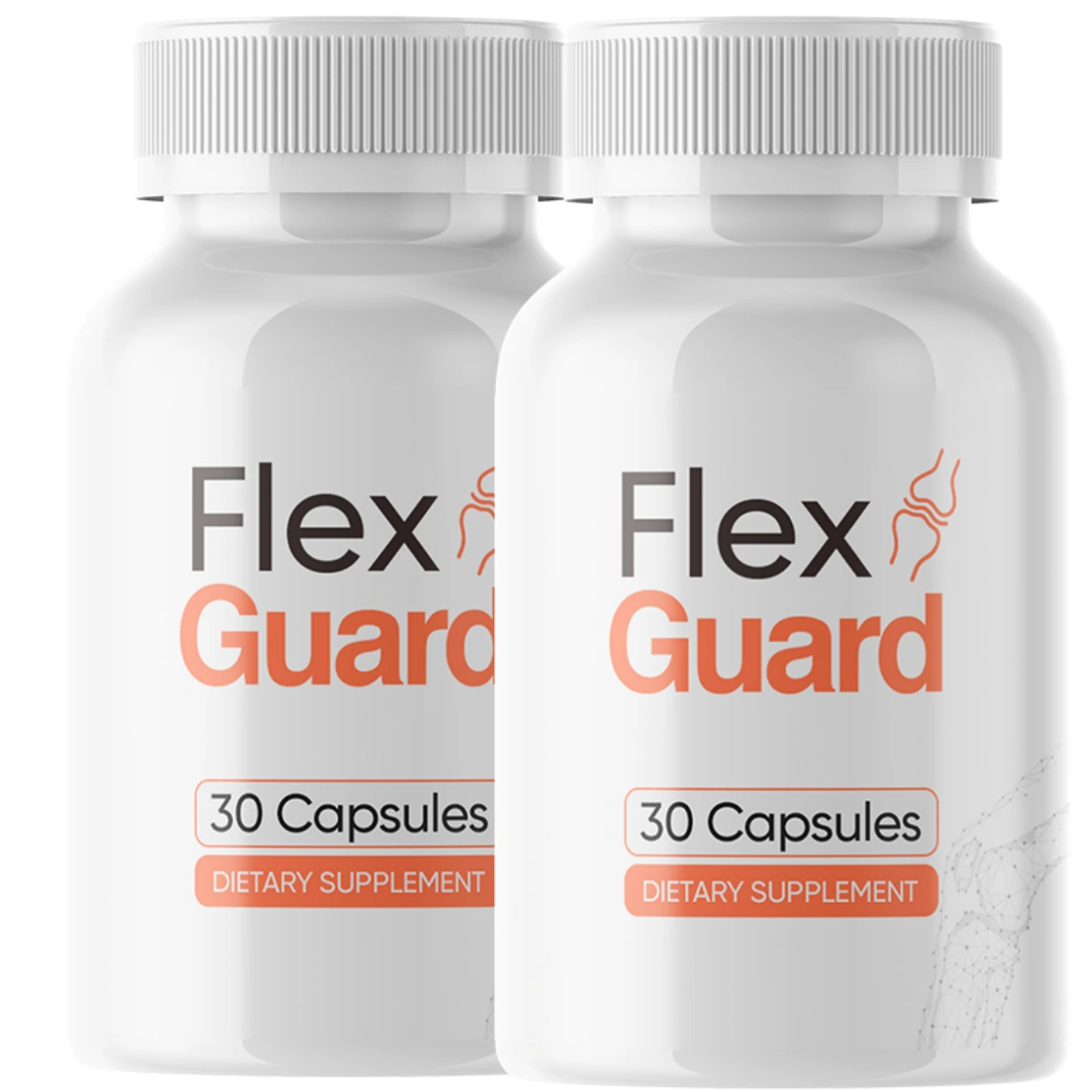
Buy enough FlexGuard to finish the experiment
A month is not long enough to judge anything on this panel and sixty days only just is. Three bottles covers the window the published work reads its results in.
Two bottles $158 · six bottles $294 · 60 days from the date of purchase
Order FlexGuard On The Official WebsiteOne capsule a day · 30 per bottle · lot FLE-26/GO-6202