FlexGuard Official Website › Supplement Facts
Supplement FactsFlexGuard Supplement Facts: The Full Label Panel
FlexGuard’s serving size is one capsule, with 30 servings per container and eight actives.
Glucosamine sulfate 500 mg, Indian frankincense 67 mg, chondroitin sulfate 50 mg and turmeric root 50 mg lead, with quercetin, methionine, MSM and bromelain at 8 mg each. Contains shellfish (crayfish).
Learn what each one does on the ingredients page.
Reproducing the label is what this desk is for, so the panel is printed here line for line rather than summarised. The carton artwork is below it so the two can be read against each other.
The FlexGuard panel as printed
Eight rows and seven other lines, transcribed from the carton in the order the carton has them.
| Amount Per Serving | Per 1 capsule | % Daily Value |
|---|---|---|
| Glucosamine Sulfate | 500 mg | † |
| Indian Frankincense (Boswellia serrata) (herb) | 67 mg | † |
| Chondroitin Sulfate | 50 mg | † |
| Turmeric (Curcuma longa) (root) | 50 mg | † |
| Quercetin (Sophora japonica) (bud) | 8 mg | † |
| Methionine | 8 mg | † |
| Methylsulfonylmethane (MSM) | 8 mg | † |
| Bromelain (Ananas comosus) (stem) | 8 mg | † |
† Daily Value not established. Serving size: 1 capsule. Servings per container: 30.
- Other ingredients. Hypromellose (vegetable capsule), rice flour.
- Contains. Shellfish (crayfish).
- Suggested use. As a dietary supplement, take one (1) capsule daily.
- Caution. Do not exceed recommended dose. Not for use by individuals under the age of 18 or pregnant or nursing mothers. Consult with a physician prior to use especially if you are taking a medication or have a medical condition.
- Storage. Store this product in a cool, dry place below 30°C (86°F).
- Seal. Keep out of reach of children. Do not use if safety seal is damaged or missing.
- Origin. Manufactured in the USA with globally sourced ingredients.
- Distributed by. North Scale, Ogden, UT. Returns do not go there: this desk's return address is in the footer of every page and a parcel needs an authorisation before it is posted.
The FlexGuard carton artwork
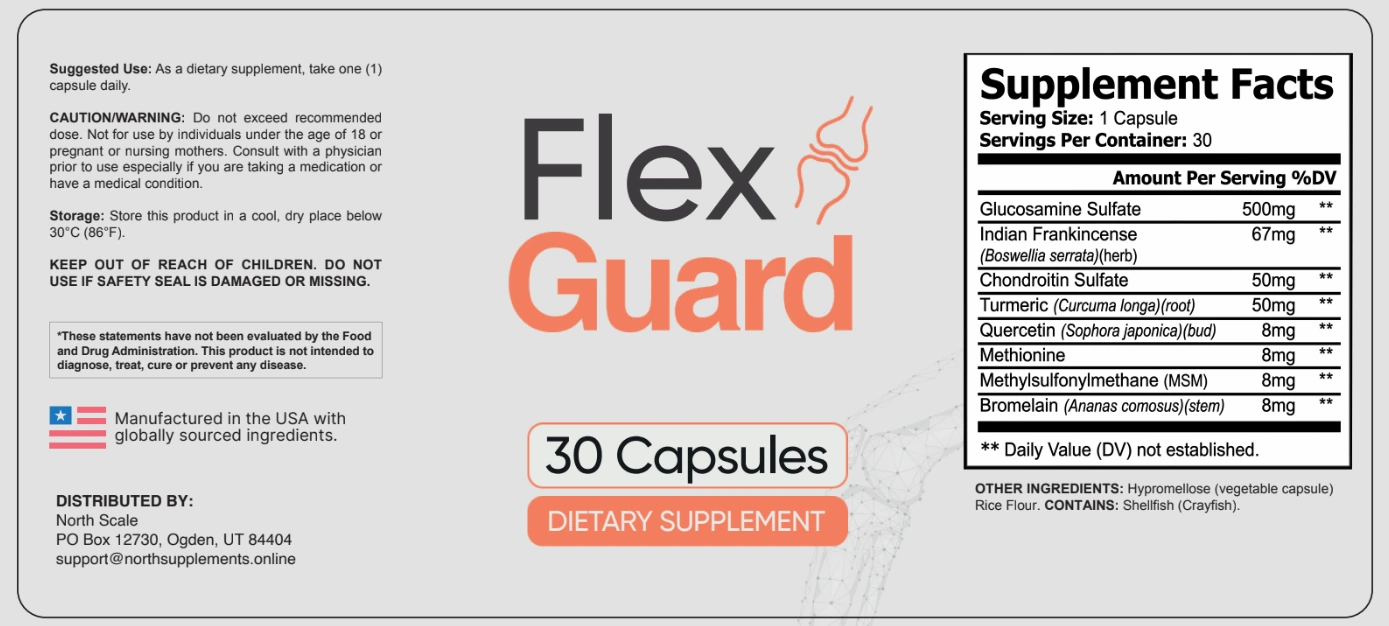
Two details on this artwork are worth naming because they answer questions people ask before buying. The distributor block gives a name and a postal address, North Scale of Ogden, Utah, which means the product has an owner you can identify. And the origin line reads manufactured in the USA with globally sourced ingredients, which is a statement about where the capsule was filled rather than where the glucosamine grew.
What the FlexGuard panel settles, and what it does not
| Question | Does the panel answer it? |
|---|---|
| How much of each active is in a capsule? | Yes. Eight rows, eight weights, no blend total. |
| What is the total active weight? | Yes, by addition: 699 mg. |
| What percentage of the Boswellia is AKBA? | No. The row gives a herb weight and no standardisation. |
| What percentage of the turmeric is curcuminoids? | No. The row names the root and gives a weight. |
| Which salt form is the glucosamine? | Yes. Sulfate, which is the form the long European trial used. |
| Where was each ingredient grown? | No. The origin line covers manufacture, not sourcing. |
| Has this lot been assayed? | No. A panel is a declaration; a certificate of analysis is a measurement. |
Seven questions, four answered. A panel is a good document and it is not every document.
Boswellia is the row with the strongest evidence behind the ingredient. The trials that produced that evidence used extracts standardised to a stated percentage of AKBA, because the active fraction is a small part of the resin. Sixty-seven milligrams of herb and 100 mg of a 30 per cent extract cannot be compared, and the carton gives the first. The federal panel rule does not require a standardisation figure, so its absence is ordinary rather than evasive.
How the FlexGuard amounts compare with the research
The full argument is on the ingredients page, which takes each row in turn. The table is repeated here because a panel without this beside it invites the assumption that a printed milligram is a researched milligram, and those are different things.
FlexGuard panel questions
Does FlexGuard publish a Supplement Facts panel?
The carton does, in full: eight actives, a milligram against each, the serving size, the servings per container, the other ingredients and the allergen line. The seller's front page does not show it, which is why this page reproduces it.
What does the symbol in the last column mean?
It marks a row with no established Daily Value. Every one of the eight rows carries it, because no reference intake has been set for glucosamine, chondroitin, Boswellia, turmeric, quercetin, methionine, MSM or bromelain. The carton uses a double dagger for it and this page uses a single one.
Is there a proprietary blend on the FlexGuard panel?
No. Every row has its own weight, which is the difference between a panel you can check and a blend total you cannot. It is the most useful thing about this label.
How much of the capsule is actually active?
699 mg of named actives. The rest is hypromellose for the shell and rice flour as filler, and the carton does not state the finished capsule weight.
Who publishes this FlexGuard panel page?
Seven sources, the first two of them the rules the panel itself has to obey.
- 21 CFR 101.36, Nutrition labeling of dietary supplements. Electronic Code of Federal Regulations. https://www.ecfr.gov/current/title-21/chapter-I/subchapter-B/part-101/subpart-F/section-101.36
- Dietary Supplement Labeling Guide. U.S. Food and Drug Administration. https://www.fda.gov/food/dietary-supplements-guidance-documents-regulatory-information/dietary-supplement-labeling-guide
- Sengupta K, Alluri KV, Satish AR, et al. A double blind, randomized, placebo controlled study of the efficacy and safety of 5-Loxin for treatment of osteoarthritis of the knee. Arthritis Res Ther. 2008;10(4):R85. PMID 18667054. Doses: 100 mg and 250 mg a day of an extract standardised to 30 per cent 3-O-acetyl-11-keto-beta-boswellic acid. Funded by the extract's manufacturer. https://pubmed.ncbi.nlm.nih.gov/18667054/
- Reginster JY, Deroisy R, Rovati LC, et al. Long-term effects of glucosamine sulphate on osteoarthritis progression: a randomised, placebo-controlled clinical trial. Lancet. 2001;357(9252):251-6. PMID 11214126. Dose: 1,500 mg once a day for three years. https://pubmed.ncbi.nlm.nih.gov/11214126/
- Kahan A, Uebelhart D, De Vathaire F, Delmas PD, Reginster JY. Long-term effects of chondroitins 4 and 6 sulfate on knee osteoarthritis: the study on osteoarthritis progression prevention, a two-year, randomized, double-blind, placebo-controlled trial. Arthritis Rheum. 2009;60(2):524-33. PMID 19180484. Dose: 800 mg a day for two years. https://pubmed.ncbi.nlm.nih.gov/19180484/
- Kuptniratsaikul V, Dajpratham P, Taechaarpornkul W, et al. Efficacy and safety of Curcuma domestica extracts compared with ibuprofen in patients with knee osteoarthritis: a multicenter study. Clin Interv Aging. 2014;9:451-8. PMID 24672232. Dose: 1,500 mg a day of Curcuma domestica extract against ibuprofen 1,200 mg a day for four weeks. https://pubmed.ncbi.nlm.nih.gov/24672232/
- Glucosamine and Chondroitin for Osteoarthritis: What You Need To Know. National Center for Complementary and Integrative Health, National Institutes of Health. https://www.nccih.nih.gov/health/glucosamine-and-chondroitin-for-osteoarthritis
More on the FlexGuard label
The FlexGuard panel arrives in the box, and it is this one
Every figure on this page is printed on the carton. If the bottle you receive differs from any of it, the bottle is the document that counts.
Two bottles $158 · six bottles $294 · 60 days from the date of purchase
Order FlexGuard On The Official WebsiteOne capsule a day · 30 per bottle · lot FLE-26/GO-6202