FlexGuard Official Website › Ingredients
IngredientsFlexGuard Ingredients: All Eight Actives and Amounts
FlexGuard lists eight active ingredients, each with a printed amount.
Glucosamine sulfate 500 mg, Boswellia serrata 67 mg, chondroitin sulfate 50 mg and turmeric root 50 mg lead, with quercetin, methionine, MSM and bromelain at 8 mg each. That is 699 mg of actives per capsule.
See the full label on the supplement facts page.
This page takes the panel row by row, largest first. Each entry gives the printed amount, what the ingredient is, and the amount the published work used, so the two can be read together instead of one at a time.
What is actually in a FlexGuard capsule?
Eight rows and one capsule. Before any of it is argued about, here is how the 699 mg divides up.
| Row | Amount | Share of the 699 mg |
|---|---|---|
| Glucosamine sulfate | 500 mg | 72% |
| Indian frankincense (Boswellia serrata) | 67 mg | 10% |
| Chondroitin sulfate | 50 mg | 7% |
| Turmeric (Curcuma longa) root | 50 mg | 7% |
| Quercetin (Sophora japonica) bud | 8 mg | 1% |
| Methionine | 8 mg | 1% |
| Methylsulfonylmethane (MSM) | 8 mg | 1% |
| Bromelain (Ananas comosus) stem | 8 mg | 1% |
Shares are rounded to the nearest whole per cent and total 100 after rounding. The arithmetic is the only thing on this page this desk did.
One row is three quarters of the capsule and seven rows share the rest. That shape is worth holding onto, because it decides how the formula should be read: this is a glucosamine capsule with seven companions rather than an eight-way blend in any meaningful sense.
The FlexGuard panel, row by row
Eight entries, each with the printed amount, what the ingredient is, and the trial amount beside it.
Glucosamine Sulfate
500 mgAn amino sugar that the body uses in building cartilage and joint fluid. Commercially it is made from shellfish shell, which is why the carton carries an allergen line, and it is sold in two salt forms that the evidence treats differently.
The three-year trial of glucosamine sulphate used 1,500 mg once a day and reported less joint space narrowing than placebo. The GAIT trial used 500 mg of the hydrochloride three times a day and found no benefit over placebo in its main analysis. A 2018 meta-analysis of the sulfate form specifically is the fairest reading of the split.
Sources: Cochrane, 2005 · NCCIH
Indian Frankincense
Boswellia serrata, herb67 mgThe resin of the Indian frankincense tree. Its boswellic acids inhibit 5-lipoxygenase, an enzyme in one of the inflammatory pathways, and it is the one plant in this category whose recent record has improved rather than faded.
The 2025 network meta-analysis of 39 trials ranked it first among the supplements it compared for pain and stiffness. The dose-ranging trial used 100 mg and 250 mg a day of an extract standardised to 30 per cent AKBA; an earlier trial used 333 mg three times a day of crude extract. This row gives a weight and no standardisation, so it can be compared with neither figure cleanly.
Sources: meta-analysis, 2020
Chondroitin Sulfate
50 mgA long sugar chain found in cartilage, usually sold alongside glucosamine and almost never alone. The Cochrane review pooled 43 trials and 9,110 people and found a small improvement in pain in the shorter studies, with the effect shrinking as trial quality rose.
The two-year STOPP trial used 800 mg a day. A 2024 meta-analysis of the pair looked at whether combining the two beats either alone. Fifty milligrams is a sixteenth of the STOPP amount, which is the widest single gap on this panel in proportional terms after the four 8 mg rows.
Turmeric
Curcuma longa, root50 mgThe most-trialled botanical in joint research. An umbrella review of eleven meta-analyses found consistent improvement in pain scores, and a 367-patient trial put 1,500 mg a day of extract against ibuprofen 1,200 mg a day for four weeks.
Absorption is the known problem: curcumin taken alone reaches the blood poorly, which is why most products add something to raise it. This row names the root, gives 50 mg, and names no absorption aid. A liver-injury case series is worth knowing about for high-dose turmeric products, though not at this amount.
Sources: NCCIH turmeric
Quercetin
Sophora japonica, bud8 mgA flavonoid, here sourced from the Japanese pagoda tree rather than from onions or apples where most dietary quercetin comes from. It has attracted recent interest as a senolytic, meaning a compound that clears worn-out cells.
The pooled osteoarthritis evidence is preclinical: animal models and laboratory work. There is no randomised trial of quercetin in human joints at any amount, which makes 8 mg a number with nothing to compare it to rather than a small version of something larger.
Methionine
8 mgAn essential sulfur-containing amino acid, present in every protein-rich food. It is the body's raw material for S-adenosylmethionine.
That distinction is the whole of this row. The joint evidence belongs to S-adenosylmethionine, which was studied at 600 to 1,200 mg a day and compared with anti-inflammatories. Methionine is the precursor, not the compound, and a normal day's food supplies well over a gram of it.
Methylsulfonylmethane
MSM8 mgAn organosulfur compound, sold on the idea that it supplies usable sulfur. The 2017 review sets out how it is normally used: 1.5 to 6 grams a day.
A 2023 trial in mild knee pain used 2 grams a day for twelve weeks, and an earlier systematic review called the evidence promising and thin in the same sentence. Eight milligrams is roughly a two-hundred-and-fiftieth of that 2 gram amount.
Bromelain
Ananas comosus, stem8 mgA mixture of protein-digesting enzymes from pineapple stem, used in Europe in enzyme preparations for swelling after injury.
An open dose-ranging study gave 200 mg and 400 mg a day and saw more at the higher amount. A placebo-controlled pilot at 800 mg a day did not beat placebo, and a 16-week WOMAC trial used 1,890 mg a day of a bromelain preparation. The honest summary is that the evidence is mixed at hundreds of milligrams and absent at eight.
What else is in the FlexGuard capsule?
Two other ingredients: hypromellose and rice flour. Hypromellose is a plant cellulose used to make the capsule shell, which is why this capsule suits a vegetarian diet where a gelatin shell would not. Rice flour is the filler that takes up the space the actives do not.
A two-item other-ingredients line is short for this shelf. There is no magnesium stearate, no silica, no titanium dioxide and no colouring listed, and the absence of a long list is a small point in the product's favour rather than a large one.
Those two facts sit next to each other on the same carton and they answer two different questions. The shell contains no animal product. The glucosamine inside it is made from crayfish shell, and the carton says so on its allergen line.
Where the FlexGuard amounts sit against the research
This is the same table the home page carries and it is the only place on this page where the comparison is made, because making it eight separate times is how a product page turns into a complaint.
The pattern is consistent: the further down the panel you read, the wider the gap. Glucosamine at a third of trial, Boswellia in a range that cannot be resolved without a standardisation figure, chondroitin at a sixteenth, turmeric at a thirtieth, and four rows at 8 mg where the studied amounts run from 200 mg to 6 grams.
Two documents, and what each FlexGuard list leaves out
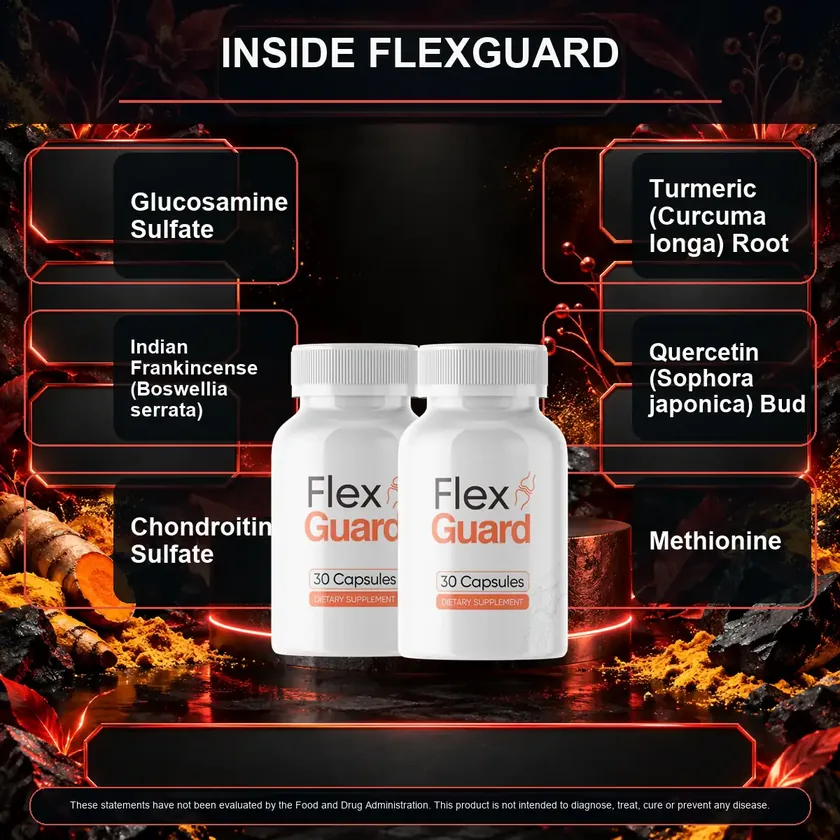
The seller publishes an INSIDE FLEXGUARD graphic. It names glucosamine sulfate, Indian frankincense, chondroitin sulfate, turmeric, quercetin and methionine, and its last panel is left blank.
MSM and bromelain are on the carton's panel and not on that graphic. Neither document contradicts the other about an amount; the graphic is simply the shorter of the two.
The panel is the complete list and the one this site uses throughout. Where a product publishes two ingredient lists, taking the longer one is the only safe rule, because it is the one that names every substance you would be swallowing.
FlexGuard ingredient questions
How many ingredients does FlexGuard have?
Eight actives on the printed panel, plus two other ingredients: hypromellose, which is the capsule shell, and rice flour. The seller's own ingredient graphic names six of the eight, leaving out MSM and bromelain.
Which ingredient is the largest?
Glucosamine sulfate at 500 mg. It is 72 per cent of the 699 mg of actives in the capsule, and the remaining seven rows share the other 199 mg.
Is the glucosamine sulfate or hydrochloride?
Sulfate, as printed. That matters because the long trials divide along that line: the three-year European trial used glucosamine sulfate and the American GAIT trial used the hydrochloride.
Does FlexGuard contain turmeric or curcumin?
Turmeric root at 50 mg. Curcumin is the best-studied compound inside turmeric, and the carton names the root rather than a curcuminoid percentage, so what fraction of that 50 mg is curcumin is not something the label settles.
Who publishes this FlexGuard ingredient page?
Twenty-four sources, one or more against every row on the panel, each linked in the sentence that uses it.
- Clegg DO, Reda DJ, Harris CL, et al. Glucosamine, chondroitin sulfate, and the two in combination for painful knee osteoarthritis. N Engl J Med. 2006;354(8):795-808. PMID 16495392. Dose: glucosamine hydrochloride 500 mg three times a day, chondroitin sulfate 400 mg three times a day, for 24 weeks. https://pubmed.ncbi.nlm.nih.gov/16495392/
- Towheed TE, Maxwell L, Anastassiades TP, et al. Glucosamine therapy for treating osteoarthritis. Cochrane Database Syst Rev. 2005;2005(2):CD002946. PMID 15846645. https://pubmed.ncbi.nlm.nih.gov/15846645/
- Reginster JY, Deroisy R, Rovati LC, et al. Long-term effects of glucosamine sulphate on osteoarthritis progression: a randomised, placebo-controlled clinical trial. Lancet. 2001;357(9252):251-6. PMID 11214126. Dose: 1,500 mg once a day for three years. https://pubmed.ncbi.nlm.nih.gov/11214126/
- Knapik JJ, Pope R, Hoedebecke SS, et al. Effects of oral glucosamine sulfate on osteoarthritis-related pain and joint-space changes: systematic review and meta-analysis. J Spec Oper Med. 2018;18(4):139-147. PMID 30566740. https://pubmed.ncbi.nlm.nih.gov/30566740/
- Glucosamine and Chondroitin for Osteoarthritis: What You Need To Know. National Center for Complementary and Integrative Health, National Institutes of Health. https://www.nccih.nih.gov/health/glucosamine-and-chondroitin-for-osteoarthritis
- Singh JA, Noorbaloochi S, MacDonald R, Maxwell LJ. Chondroitin for osteoarthritis. Cochrane Database Syst Rev. 2015;1(1):CD005614. PMID 25629804. Forty-three trials, 9,110 participants, most using 800 to 1,200 mg a day. https://pubmed.ncbi.nlm.nih.gov/25629804/
- Kahan A, Uebelhart D, De Vathaire F, Delmas PD, Reginster JY. Long-term effects of chondroitins 4 and 6 sulfate on knee osteoarthritis: the study on osteoarthritis progression prevention, a two-year, randomized, double-blind, placebo-controlled trial. Arthritis Rheum. 2009;60(2):524-33. PMID 19180484. Dose: 800 mg a day for two years. https://pubmed.ncbi.nlm.nih.gov/19180484/
- Rabade A, Viswanatha GL, Nandakumar K, Kishore A. Evaluation of efficacy and safety of glucosamine sulfate, chondroitin sulfate, and their combination regimen in the management of knee osteoarthritis: a systematic review and meta-analysis. Inflammopharmacology. 2024;32(3):1759-1775. PMID 38581640. https://pubmed.ncbi.nlm.nih.gov/38581640/
- Yu G, Xiang W, Zhang T, Zeng L, Yang K, Li J. Effectiveness of Boswellia and Boswellia extract for osteoarthritis patients: a systematic review and meta-analysis. BMC Complement Med Ther. 2020;20(1):225. PMID 32680575. Seven trials, 545 patients; the pooled evidence covers four weeks and longer. https://pubmed.ncbi.nlm.nih.gov/32680575/
- Sengupta K, Alluri KV, Satish AR, et al. A double blind, randomized, placebo controlled study of the efficacy and safety of 5-Loxin for treatment of osteoarthritis of the knee. Arthritis Res Ther. 2008;10(4):R85. PMID 18667054. Doses: 100 mg and 250 mg a day of an extract standardised to 30 per cent 3-O-acetyl-11-keto-beta-boswellic acid. Funded by the extract's manufacturer. https://pubmed.ncbi.nlm.nih.gov/18667054/
- Kimmatkar N, Thawani V, Hingorani L, Khiyani R. Efficacy and tolerability of Boswellia serrata extract in treatment of osteoarthritis of knee: a randomized double blind placebo controlled trial. Phytomedicine. 2003;10(1):3-7. PMID 12622457. Dose: 333 mg three times a day. https://pubmed.ncbi.nlm.nih.gov/12622457/
- Zhang Y, Gui Y, Adams R, et al. Comparative effectiveness of nutritional supplements in the treatment of knee osteoarthritis: a network meta-analysis. Nutrients. 2025;17(15):2547. PMID 40806131. Thirty-nine randomised trials, 4,599 patients; Boswellia ranked first for pain and stiffness. https://pubmed.ncbi.nlm.nih.gov/40806131/
- Kuptniratsaikul V, Dajpratham P, Taechaarpornkul W, et al. Efficacy and safety of Curcuma domestica extracts compared with ibuprofen in patients with knee osteoarthritis: a multicenter study. Clin Interv Aging. 2014;9:451-8. PMID 24672232. Dose: 1,500 mg a day of Curcuma domestica extract against ibuprofen 1,200 mg a day for four weeks. https://pubmed.ncbi.nlm.nih.gov/24672232/
- Bideshki MV, Jourabchi-Ghadim N, Radkhah N, et al. The efficacy of curcumin in relieving osteoarthritis: a meta-analysis of meta-analyses. Phytother Res. 2024;38(6):2875-2891. PMID 38576215. https://pubmed.ncbi.nlm.nih.gov/38576215/
- Halegoua-DeMarzio D, Navarro V, Ahmad J, et al. Liver injury associated with turmeric, a growing problem: ten cases from the Drug-Induced Liver Injury Network. Am J Med. 2023;136(2):200-206. PMID 36252717. https://pubmed.ncbi.nlm.nih.gov/36252717/
- Turmeric. National Center for Complementary and Integrative Health, National Institutes of Health. https://www.nccih.nih.gov/health/turmeric
- Yamaura K, Nelson AL, Nishimura H, et al. Therapeutic potential of senolytic agent quercetin in osteoarthritis: a systematic review and meta-analysis of preclinical studies. Ageing Res Rev. 2023;90:101989. PMID 37442369. The pooled evidence is preclinical: animal and laboratory work, not trials in people. https://pubmed.ncbi.nlm.nih.gov/37442369/
- Soeken KL, Lee WL, Bausell RB, Agelli M, Berman BM. Safety and efficacy of S-adenosylmethionine (SAMe) for osteoarthritis. J Fam Pract. 2002;51(5):425-30. PMID 12019049. Trial doses ran 600 to 1,200 mg a day of SAMe, which is a molecule made from methionine rather than methionine itself. https://pubmed.ncbi.nlm.nih.gov/12019049/
- Butawan M, Benjamin RL, Bloomer RJ. Methylsulfonylmethane: applications and safety of a novel dietary supplement. Nutrients. 2017;9(3):290. PMID 28300758. Human studies have used 1.5 to 6 g a day. https://pubmed.ncbi.nlm.nih.gov/28300758/
- Brien S, Prescott P, Bashir N, Lewith H, Lewith G. Systematic review of the nutritional supplements dimethyl sulfoxide (DMSO) and methylsulfonylmethane (MSM) in the treatment of osteoarthritis. Osteoarthritis Cartilage. 2008;16(11):1277-88. PMID 18417375. https://pubmed.ncbi.nlm.nih.gov/18417375/
- Toguchi A, Noguchi N, Kanno T, Yamada A. Methylsulfonylmethane improves knee quality of life in participants with mild knee pain: a randomized, double-blind, placebo-controlled trial. Nutrients. 2023;15(13):2995. PMID 37447322. Dose: 2 g a day for twelve weeks. https://pubmed.ncbi.nlm.nih.gov/37447322/
- Walker AF, Bundy R, Hicks SM, Middleton RW. Bromelain reduces mild acute knee pain and improves well-being in a dose-dependent fashion in an open study of otherwise healthy adults. Phytomedicine. 2002;9(8):681-6. PMID 12587686. Doses: 200 mg and 400 mg a day for one month. https://pubmed.ncbi.nlm.nih.gov/12587686/
- Brien S, Lewith G, Walker AF, Middleton R, Prescott P, Bundy R. Bromelain as an adjunctive treatment for moderate-to-severe osteoarthritis of the knee: a randomized placebo-controlled pilot study. QJM. 2006;99(12):841-50. PMID 17121765. Dose: 800 mg a day for twelve weeks; it did not beat placebo. https://pubmed.ncbi.nlm.nih.gov/17121765/
- Kasemsuk T, Saengpetch N, Sibmooh N, Unchern S. Improved WOMAC score following 16-week treatment with bromelain for knee osteoarthritis. Clin Rheumatol. 2016;35(10):2531-40. PMID 27470088. Dose: 1,890 mg a day of a bromelain-containing preparation. https://pubmed.ncbi.nlm.nih.gov/27470088/
More on the FlexGuard formula
Read the FlexGuard panel, then decide on the pack
Every amount on this page is printed on the carton you will receive, so you can check the page against the bottle rather than trusting either on its own.
Two bottles $158 · six bottles $294 · 60 days from the date of purchase
Order FlexGuard On The Official WebsiteOne capsule a day · 30 per bottle · lot FLE-26/GO-6202