FlexGuard Official Website › Blog › Glucosamine 500 mg vs The Trial Schedule
Glucosamine At 500 mg, And The Schedule The Trials Actually Used
- Every trial worth quoting used 1,500 mg a day of glucosamine.
- The largest of them gave 500 mg three times a day, not once.
- Glucosamine sulfate and hydrochloride have different evidence records.
- One capsule of 500 mg is a third of the amount, and 72 per cent of this panel.
- Even at the full amount the evidence is divided, which changes how to read a small one.
What glucosamine is, and where it comes from
Glucosamine is an amino sugar. The body makes it, and it is a building block of glycosaminoglycans, which are among the components of cartilage and of the fluid that lets a joint run smoothly.
Commercially it is not made in a laboratory from scratch. It is extracted from chitin, and chitin comes from the shells of crustaceans, which is why almost every glucosamine bottle on a shelf carries a shellfish declaration and why this one reads CONTAINS: SHELLFISH (CRAYFISH). That is a property of the ingredient rather than a sign of contamination.
It has been the anchor of the joint supplement shelf for three decades, which means two things at once. There is more trial evidence about it than about anything else in the category, and there is more marketing attached to it than the evidence comfortably supports.
The amount every trial used, and how it was divided
The figure to carry around is 1,500 mg a day. It appears in essentially every trial that anybody quotes, and the interesting part is not the total but how it was delivered.
The GAIT trial, which is the largest and best-funded of them, gave 500 mg of glucosamine hydrochloride three times a day, alongside 400 mg of chondroitin sulfate three times a day in one of its arms. The three-year European trial gave 1,500 mg of glucosamine sulphate as a single daily dose dissolved in water.
Those two designs are not interchangeable. Splitting a dose across a day produces a different exposure pattern from one large dose, and a single dose of 1,500 mg is a different thing again from one capsule of 500 mg.
| Trial | What it gave | How often | For how long |
|---|---|---|---|
| GAIT | 500 mg glucosamine hydrochloride | Three times a day | 24 weeks |
| The three-year European trial | 1,500 mg glucosamine sulphate | Once a day | 3 years |
| The Cochrane pool | Mostly 1,500 mg a day | Varies by trial | 4 weeks to 3 years |
| This carton | 500 mg glucosamine sulfate | Once a day | As long as you take it |
Three published designs and one product, set in the same table so the difference is arithmetic rather than rhetorical.
Sulfate or hydrochloride: the split that runs through the evidence
There are two salts in common use and the evidence divides along them in a way that is either a crucial detail or a coincidence, depending on who you ask.
The positive long-term results come from glucosamine sulphate, largely from European trials using one particular crystalline preparation. The prominent null result comes from glucosamine hydrochloride in GAIT. A 2018 meta-analysis that looked at the sulfate form specifically is the fairest attempt to separate the two, and it is worth reading before anybody tells you the question is settled either way.
The Cochrane review made the same observation from the other direction: when the analysis was restricted to one manufacturer's preparation the effect appeared, and when it was not, it largely did not.
Practically, a label that says sulfate is on the side of the evidence that looks better. This carton says sulfate.
What 500 mg once a day is, in proportion
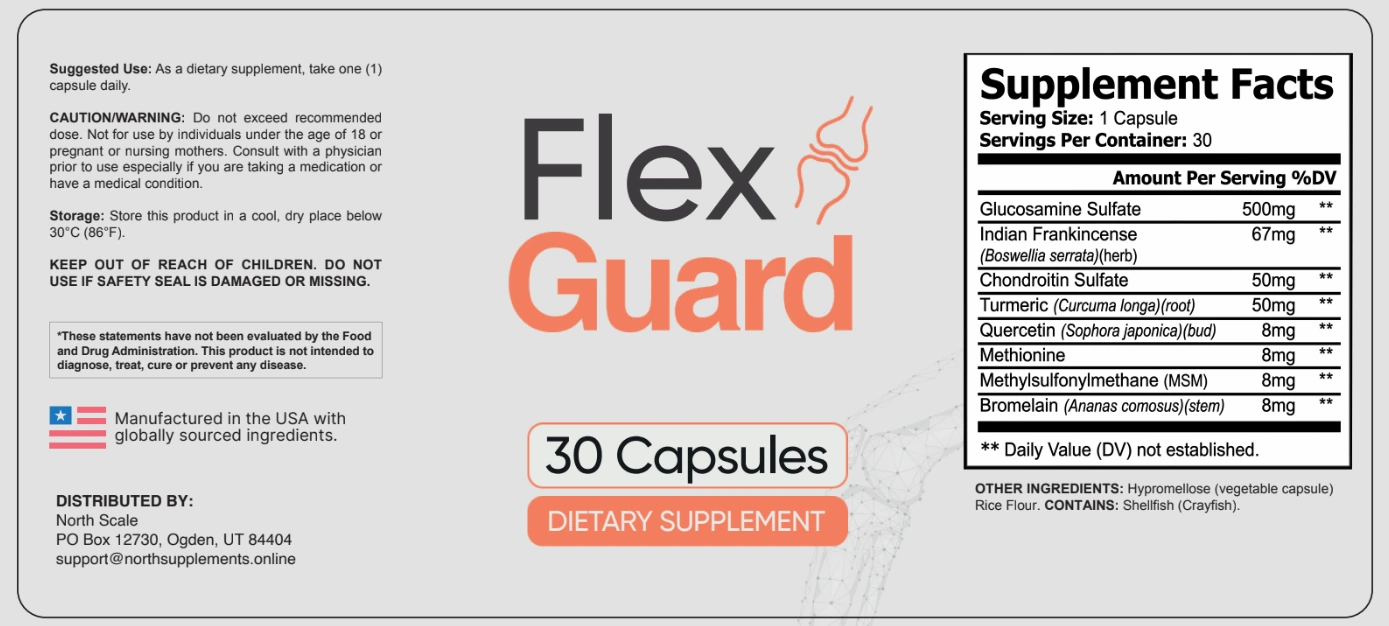
Five hundred milligrams is a third of 1,500. Put beside the four rows at the bottom of this panel, which sit at 8 mg against trial amounts in the hundreds and thousands, a third is generous.
It is also 72 per cent of the 699 mg of actives in the capsule, which is worth saying because it reframes the product. This is not an eight-way blend in any meaningful sense. It is a glucosamine capsule with seven companions, and the companions share 199 mg between them.
Whether a third of a tested amount does a third of something, or nothing at all, is not a question anybody has run a trial to answer. The honest position is that it has not been tested at this amount, which is different from having been tested and failed.
- 1,500 mg a day is the trial amount, in almost every study.
- 500 mg once a day is what one of these capsules delivers.
- Three times a day is how GAIT split its 1,500 mg.
- 72 per cent of this capsule's actives are this one ingredient.
- 199 mg is what the other seven rows share between them.
FlexGuard prints the salt form and the amount
Glucosamine sulfate 500 mg is the first row on the panel and the word sulfate is printed. Every other row carries a milligram too, which is what lets you run the multiplication in this post.
Two bottles $158 · six bottles $294 · 60 days from the date of purchase
Order FlexGuard On The Official WebsiteOne capsule a day · 30 per bottle · lot FLE-26/GO-6202
Why a once-daily capsule cannot carry the trial amount
A capsule has a fixed internal volume and 699 mg is already a reasonably full one. Reaching 1,500 mg of glucosamine alone would need roughly twice the contents of this capsule, with nothing else in it at all.
That is why every product that does reach the trial amount is either a three-capsules-a-day product or a powder. It is a physical constraint rather than a commercial decision, and a once-daily joint capsule is agreeing to it the moment it prints one a day on the front of the box.
So the promise on the front and the amounts on the back are the same decision seen from two sides. A buyer who wants convenience is buying a smaller amount. A buyer who wants the researched amount is buying three capsules a day, or a scoop. Neither choice is wrong and nobody should be surprised by the consequence.
Three capsules a day at 500 mg each would deliver the trial amount of glucosamine and nothing else. One capsule a day carrying eight ingredients delivers a third of it plus seven small amounts. Those are two different products, and a shelf sells them side by side at similar prices.
What the evidence says even at the full amount
Here is the part that makes this post less useful to a seller than it looks. Even at 1,500 mg a day, the evidence is genuinely divided.
GAIT found no benefit over placebo on its primary outcome. The three-year trial reported less joint space narrowing than placebo. The Cochrane review found that the effect depended heavily on which preparation was tested, which is the pattern you would see if one preparation worked and also the pattern you would see if one sponsor's trials were more optimistic than everybody else's.
The NIH centre's own summary lands where most careful readers land: some people report relief, the trial evidence is mixed, and it is not harmful for most people to try it.
That matters for how to read a low amount. If the full amount were reliably effective, a third of it would be a clear shortfall. Because the full amount is contested, a third of it is a smaller version of a contested thing, which is a harder sentence to write and a more accurate one.
| Finding | What it supports | What it does not |
|---|---|---|
| Three-year sulphate trial | A long-term structural effect at 1,500 mg once a day | Any conclusion about 500 mg, or about hydrochloride |
| GAIT null result | Caution about hydrochloride at 1,500 mg split in three | A claim that glucosamine as a class does nothing |
| Cochrane's preparation split | That the preparation matters as much as the molecule | A single number for the whole ingredient |
| This carton at 500 mg | Nothing tested. It is below every published design | A claim in either direction |
Four rows, and the fourth is the one a product page usually leaves out.
How long it takes before any of this is answerable
There is one more thing that has to be said before any of the above can be acted on, and it is about time rather than about amount.
The trials that report something from glucosamine are long. The European trial ran three years. The shortest entries in the Cochrane pool are a month, and a month of a cartilage ingredient is a measurement of a pain score rather than of anything structural.
That has a practical consequence for pack size. A single thirty-capsule bottle is thirty days, and thirty days is shorter than the shortest useful study of this ingredient. Whatever amount you settle on, buying less than about three months of it means running an experiment that cannot produce an answer, and then concluding something from the result.
It also means a refund window and an assessment point are two different dates that have to be held in the same head. Sixty days of window against eight to twelve weeks of waiting is a tight fit, and it is the reason this desk points at the middle pack on the pricing page rather than the cheapest one.
What to do with this if you are standing in a shop
Read the salt form first. Sulfate is on the better-evidenced side and the word is on the panel or it is not.
Then do the multiplication. Take the amount per capsule, multiply by the daily serving, and compare it with 1,500 mg. A product that reaches it will say so loudly and will ask you to take more than one capsule. A product that does not is offering convenience, and convenience is a real thing to want.
Then decide which of the two you are actually buying. A broad once-daily capsule is a reasonable habit at a modest amount. A single-ingredient product at 1,500 mg is an attempt to reproduce a trial. Buying the first and expecting the second is the commonest disappointment in this category, and it is entirely avoidable in the shop.
- Look for the word sulfate on the panel.
- Multiply the per-capsule amount by the daily serving.
- Compare the result with 1,500 mg.
- Check the allergen line, because glucosamine usually means shellfish.
- Decide whether you are buying a habit or a trial dose, and buy that one.
The full row-by-row comparison for this carton, including the seven other ingredients, is on the ingredients page, and the amounts each of their own trials used sit beside them there.
- Clegg DO, Reda DJ, Harris CL, et al. Glucosamine, chondroitin sulfate, and the two in combination for painful knee osteoarthritis. N Engl J Med. 2006;354(8):795-808. PMID 16495392. Dose: glucosamine hydrochloride 500 mg three times a day, chondroitin sulfate 400 mg three times a day, for 24 weeks. https://pubmed.ncbi.nlm.nih.gov/16495392/
- Reginster JY, Deroisy R, Rovati LC, et al. Long-term effects of glucosamine sulphate on osteoarthritis progression: a randomised, placebo-controlled clinical trial. Lancet. 2001;357(9252):251-6. PMID 11214126. Dose: 1,500 mg once a day for three years. https://pubmed.ncbi.nlm.nih.gov/11214126/
- Towheed TE, Maxwell L, Anastassiades TP, et al. Glucosamine therapy for treating osteoarthritis. Cochrane Database Syst Rev. 2005;2005(2):CD002946. PMID 15846645. https://pubmed.ncbi.nlm.nih.gov/15846645/
- Knapik JJ, Pope R, Hoedebecke SS, et al. Effects of oral glucosamine sulfate on osteoarthritis-related pain and joint-space changes: systematic review and meta-analysis. J Spec Oper Med. 2018;18(4):139-147. PMID 30566740. https://pubmed.ncbi.nlm.nih.gov/30566740/
- Glucosamine and Chondroitin for Osteoarthritis: What You Need To Know. National Center for Complementary and Integrative Health, National Institutes of Health. https://www.nccih.nih.gov/health/glucosamine-and-chondroitin-for-osteoarthritis
Read the FlexGuard panel and do the multiplication yourself
Every amount on this carton is printed, which is the only reason the arithmetic in this post is possible at all.
Two bottles $158 · six bottles $294 · 60 days from the date of purchase
Order FlexGuard On The Official WebsiteOne capsule a day · 30 per bottle · lot FLE-26/GO-6202