FlexGuard Official Website › Blog › How Does FlexGuard Work? 3 Routes on the Label
How Does FlexGuard Work? 3 Routes on the Label, Step by Step
FlexGuard puts three kinds of ingredient in one capsule: cartilage building blocks, plant compounds, and sulfur, enzyme and amino acid rows. The seller's own graphic claims no mechanism, so the story comes from the label. A mechanism is only a reason something could work. The amount is the reason it might.
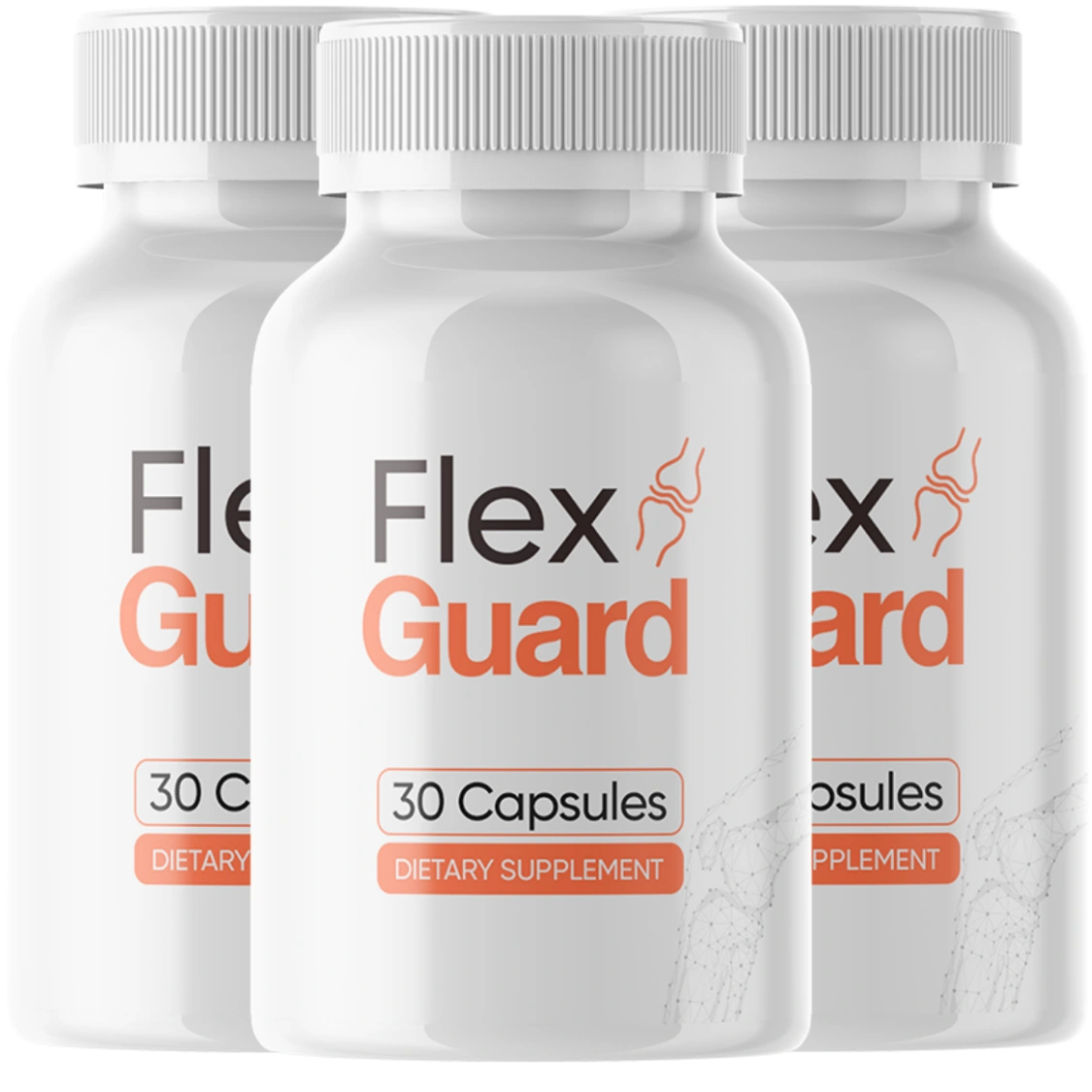
Curious how the label reads in person?
The carton prints every amount, and the order page shows the live price and the guarantee. Take a look when you are ready.
See today’s price and guaranteeThis site is a retailer and is paid when you order through it. The checkout shows the live price. The 60-day window is worded two ways, and the guarantee page shows both.
- The seller's HOW FLEXGUARD WORKS graphic has four steps: daily use, capsule formula, daily routine and follow the label.
- Route one is glucosamine sulfate (500 mg) and chondroitin sulfate (50 mg), the cartilage building blocks.
- Route two is Boswellia serrata (67 mg) and turmeric root (50 mg), studied for inflammatory signalling.
- Route three is quercetin, methionine, MSM and bromelain, at 8 mg each.
- The carton claims support for joint comfort and mobility. It makes no anti-inflammatory claim.
- FlexGuard does not rebuild cartilage, is not a painkiller and is not FDA approved.
What does the seller say FlexGuard does?
The seller's graphic is short. It shows four numbered steps: daily use, capsule formula, daily routine and follow the label. Read as a mechanism, that says nothing at all. Read as a note about habit, it is fair and restrained.
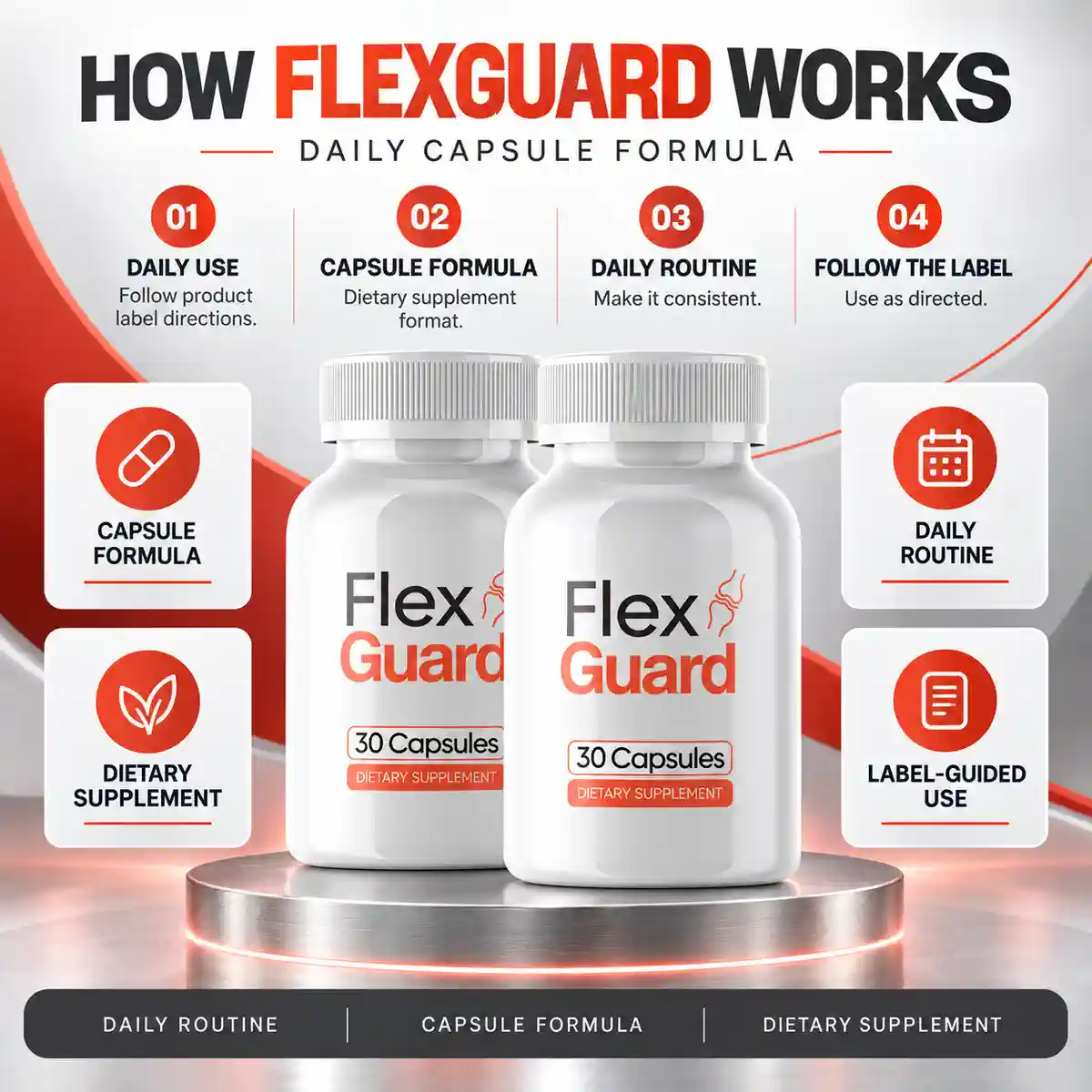
There is a plus side. A seller that names no mechanism cannot be caught overclaiming one. There is a cost too. If you want to know how the capsule is meant to act, you must go to the label and the research. That is what the steps below do.
Step 1: What is route one, the cartilage building blocks?
Glucosamine and chondroitin are both found in cartilage and in the fluid that cushions a joint. The idea is simple: supply the raw materials, and the tissue has more to work with.
It is the most tested idea in the category, and the results are divided. A three-year trial of glucosamine sulphate at 1,500 mg a day reported less narrowing of the joint space than placebo. The GAIT trial gave 500 mg of glucosamine hydrochloride three times a day, with or without chondroitin, and found no benefit over placebo in its main result. The Cochrane review of chondroitin found a small benefit that shrank as trials got better.
Nearly all of those trials share one thing: the amount. They used 1,500 mg of glucosamine a day and 800-1,200 mg of chondroitin. FlexGuard carries 500 mg and 50 mg. The large trials also split the glucosamine into three doses, which is not the same exposure as one morning capsule.
Step 2: What is route two, the plant compounds?
Boswellic acids from Indian frankincense are described in research as blocking 5-lipoxygenase, an enzyme in one arm of inflammatory signalling. Curcuminoids from turmeric act on several pathways at once.
This is where the category's best recent result sits. A 2025 network meta-analysis of 39 trials with 4,599 patients ranked Boswellia first for pain and stiffness among the supplements it compared. An earlier meta-analysis of seven trials, with 545 patients, agreed on a smaller pool.
The catch on this label is the type of row, not the size. Boswellia trials used extracts standardised to 30 per cent AKBA. The carton prints 67 mg of herb and no standardisation. The two cannot be compared. The same goes for turmeric: the carton names the root and does not say how much of the 50 mg is curcumin.
Step 3: What is route three, the sulfur, enzyme and amino acid rows?
MSM supplies sulfur, which the body uses in connective tissue. Bromelain is a protein-digesting enzyme from pineapple stem. Quercetin is a flavonoid. Methionine is an amino acid, and the starting material for a different molecule, S-adenosylmethionine.
All four sit at 8 mg. Here is what the research used:
- MSM: 1.5-6 g a day in human studies, and 2 g a day for twelve weeks in a 2023 knee trial.
- Bromelain: 200-1,890 mg a day, with no benefit over placebo at 800 mg in the best-controlled trial.
- Quercetin: no randomised trial in human joints at any amount.
- Methionine: no joint evidence of its own. The joint record belongs to S-adenosylmethionine at 600-1,200 mg a day.
These are the rows where the mechanism is easy to say in a sentence and the amount makes it academic.
Step 4: Does the amount decide the result?
A mechanism says what could happen. The amount says whether enough is present for it to happen. Put the three routes next to the capsule and the picture is clear.
| Route | Rows | Thought to act on | Per capsule |
|---|---|---|---|
| One | Glucosamine sulfate, chondroitin sulfate | Cartilage and joint fluid | 500 mg and 50 mg |
| Two | Boswellia serrata, turmeric root | Inflammatory signalling | 67 mg and 50 mg |
| Three | Quercetin, methionine, MSM, bromelain | Sulfur supply, swelling, cell clearance | 8 mg each |
The third column describes a proposed mechanism in research. It is not an effect on a person.
Total named actives come to 699 mg, and glucosamine alone is 72 per cent of that. Seven rows share the remaining 199 mg. In practice this is a glucosamine capsule with seven companions, not an even eight-way blend.
Step 5: Is FlexGuard an anti-inflammatory?
This is a common search, so it needs a clear answer. The carton does not claim it. It claims support for joint comfort and mobility, and help coping with everyday joint stress. It does not claim to treat inflammation or any named condition.
When research says Boswellia or turmeric acts on inflammatory signalling, that is a statement about the ingredient at the amounts tested. It is not a promise about this capsule. Keep the two apart.
FlexGuard is a dietary supplement. It is not a medicine, and it should not replace anything a doctor has told you to take.
What can FlexGuard not do?
Three limits are worth stating plainly, because they come from the mechanism itself.
- It does not rebuild cartilage that has gone.
- It does not block pain the way an analgesic does, so expect nothing within an hour of a capsule.
- No named condition, arthritis included, is treated, prevented or managed by it.
The rheumatology guideline the site cites puts exercise, weight management and self-management ahead of every supplement. A capsule is an addition to those, not a replacement.
Nothing here treats, cures or prevents any disease, and FlexGuard is not FDA approved, as no dietary supplement is. These statements have not been evaluated by the Food and Drug Administration. Medical questions belong with your own doctor. Swelling, heat, a joint that locks or gives way, or pain that wakes you at night should be looked at by a clinician rather than managed with a capsule.
Frequently asked questions
How does FlexGuard work?
The seller claims no mechanism. By its label, it combines cartilage building blocks, two plant extracts and four small rows, all aimed at joint comfort and mobility. The amounts sit below most research amounts.
What does FlexGuard do?
The carton claims support for joint comfort and mobility, and help coping with everyday joint stress. It does not treat any disease and is not a painkiller.
Is FlexGuard an anti-inflammatory?
The carton makes no such claim. Research describes Boswellia and turmeric as acting on inflammatory signalling at the amounts tested, which are higher than the amounts in this capsule.
Which ingredient does most of the work?
That is not published. Glucosamine sulfate is the largest row at 500 mg, or 72 per cent of the 699 mg of actives, but a bigger row is not proof of a bigger effect.
Does it act within a week?
No. No row on the panel has been shown to act within days. Buyers at this desk most often name 3-6 weeks, and trials read their results at 8-12 weeks.
Is it safe with my medicines?
Ask your doctor or pharmacist. Glucosamine has a case record of raising INR with warfarin, and turmeric has its own antiplatelet signal. The carton also says to consult a physician if you take a medication.
Sources named on this site
- The GAIT trial: https://pubmed.ncbi.nlm.nih.gov/16495392/
- The three-year glucosamine sulphate trial: https://pubmed.ncbi.nlm.nih.gov/11214126/
- The Cochrane review of chondroitin: https://pubmed.ncbi.nlm.nih.gov/25629804/
- The 2020 Boswellia meta-analysis: https://pubmed.ncbi.nlm.nih.gov/32680575/
- The 2025 network meta-analysis of joint supplements: https://pubmed.ncbi.nlm.nih.gov/40806131/
- The 2024 umbrella review of eleven curcumin meta-analyses: https://pubmed.ncbi.nlm.nih.gov/38576215/
- The 2023 MSM knee trial: https://pubmed.ncbi.nlm.nih.gov/37447322/
- The placebo-controlled bromelain pilot: https://pubmed.ncbi.nlm.nih.gov/17121765/
- The meta-analysis of S-adenosylmethionine: https://pubmed.ncbi.nlm.nih.gov/12019049/
- The American College of Rheumatology's osteoarthritis guideline: https://pubmed.ncbi.nlm.nih.gov/31908163/
Our view
The mechanism story is a fair one. Cartilage building blocks, plant compounds and a few supporting rows are all things researchers have looked at. We like that the seller does not claim more than a four-step graphic.
But a reason something could work is not a reason it will. This capsule carries about a third of the glucosamine used in the long trials, a sixteenth of the chondroitin, and no standardisation figure for the Boswellia. We say that plainly because it is the part that decides what to expect.
If the idea appeals, treat it as a modest daily habit with a 60-day window, and judge it on a calendar. Speak to a doctor first if you take blood thinners or have a medical condition.
Last updated
Ready to see the full panel in the box?
Every figure on this page is printed on the carton you would receive. If the bottle differs from the page, the bottle counts.
See today’s price and guaranteeWe earn a payment on orders placed through this site, because it is a retailer. The live price is at the checkout, and it wins over any page. Read the guarantee wording on the guarantee page first.